|
Lathe
Instructions
|
|||||
 |
|||||
Click for metal turning LATHES webpage
INSTRUCTIONS TO LEARN HOW TO USE A LATHE
PAGE 2 OF 3
Click to return to HOW TO USE A LATHE - Page 1 of 3
This webpage is best printed in Landscape format.
Parting
Parting is the process of cutting off a piece of stock while it is being held in the lathe. This process uses a specially shaped tool bit with a cutting edge similar to that of a square-nosed tool bit. When parting, be sure to use plenty of coolant, such as a sulfurized cutting oil (machine cast iron dry). Parting tools normally have a 5° side rake and no back rake angles. The blades are sharpened by grinding the ends only. Parting is used to cut off stock, such as tubing, that is impractical to saw off with a power hacksaw.
Parting is also used to cut off work after other machining operations have been completed (Figure 7-59). Parting tools can be of the forged type, inserted blade type, or ground from a standard tool blank. In order for the tool to have maximum strength, the length of the cutting portion of the blade should extend only enough to be slightly longer than half of the workpiece diameter (able to reach the center of the work). Never attempt to part while the work is mounted between centers.
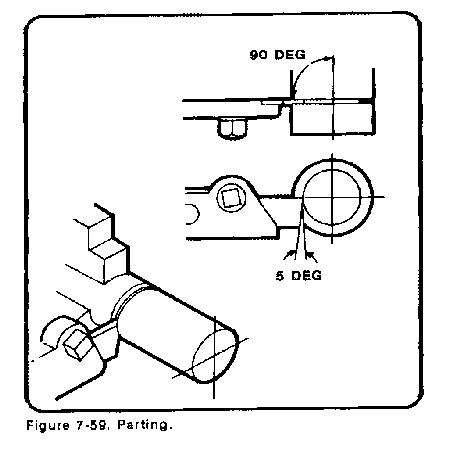
Work that is to be parted should be held rigidly in a chuck or collet, with the area to be parted as close to the holding device as possible. Always make the parting cut at a right angle to the centerline of the work. Feed the tool bit into the revolving work with the cross slide until the tool completely severs the work. Speeds for parting should be about half that used for straight turning. Feeds should be light but continuous. If chatter occurs, decrease the feed and speed, and check for loose lathe parts or a loose setup. The parting tool should be positioned at center height unless cutting a piece that is over 1-inch thick. Thick pieces should have the cutting tool just slightly above center to account for the stronger torque involved in parting. The length of the portion to be cut off can be measured by using the micrometer carriage stop or by using layout lines scribed on the workpiece. Always have the carriage locked down to the bed to reduce vibration and chatter. Never try to catch the cutoff part in the hand; it will be hot and could burn.
RADII AND FORM TURNING
Occasionally, a radius or irregular shape must be machined on the lathe. Form turning is the process of machining radii and these irregular shapes. The method used to form-turn will depend on the size and shape of the object, the accuracy desired, the time allowed, and the number of pieces that need to be formed. Of the several ways to form-turn, using a form turning tool that is ground to the shape of the desired radius is the most common. Other common methods are using hand manipulation and filing, using a template and following rod, or using the compound rest and tool to pivot and cut. Two radii are cut in form turning, concave and convex. A concave radius curves inward and a convex radius curves outward.
Forming a Radius Using a Form Turning Tool
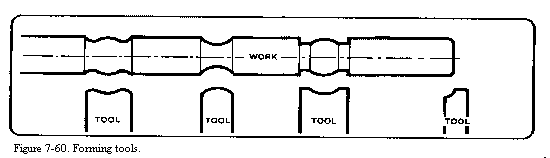
Using a form turning tool to cut a radius is a way to form small radii and contours that will fit the shape of the tool. Forming tools can be ground to any desired shape or contour (Figure 7-60), with the only requirements being that the proper relief and rake angles must be ground into the tool's shape. The most practical use of the ground forming tool is in machining several duplicate pieces, since the machining of one or two pieces will not warrant the time spent on grinding the form tool. Use the proper radius gage to check for correct fit. A forming tool has a lot of contact with the work surface, which can result in vibration and chatter. Slow the speed, increase the feed, and tighten the work setup if these problems occur.
Forming a Radius Using Hand Manipulation
Hand manipulation, or free hand, is the most difficult method of form turning to master. The cutting tool moves on an irregular path as the carriage and cross slide are simultaneously manipulated by hand. The desired form is achieved by watching the tool as it cuts and making small adjustments in the movement of the carriage and cross slide. Normally, the right hand works the cross feed movement while the left hand works the carriage movement. The accuracy of the radius depends on the skill of the operator. After the approximate radius is formed, the workpiece is filed and polished to a finished dimension.
Forming a Radius Using a Template
To use a template with a follower rod to form a radius, a full scale form of the work is laid out and cut from thin sheet metal. This form is then attached to the cross slide in such a way that the cutting tool will follow the template. The accuracy of the template will determine the accuracy of the workpiece. Each lathe model has a cross slide and carriage that are slightly different from one another, but they all operate in basically the same way. A mounting bracket must be fabricated to hold the template to allow the cutting tool to follow its shape. This mounting bracket can be utilized for several different operations, but should be sturdy enough for holding clamps and templates. The mounting bracket must be positioned on the carriage to allow for a follower (that is attached to the cross slide) to contact the template and guide the cutting tool. For this operation, the cross slide must be disconnected from the cross feed screw and hand pressure applied to hold the cross slide against the follower and template. Rough-cut the form to the approximate shape before disconnecting the cross feed screw. This way, a finish cut is all that is required while applying hand pressure to the cross slide. Some filing may be needed to completely finish the work to dimension.
Forming a Radius Using the Compound Rest
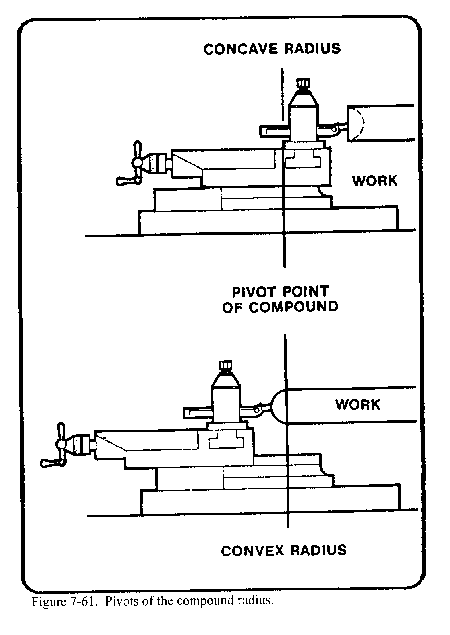
To use the compound rest and tool to pivot and cut (Figure 7-61), the compound rest bolts must be loosened to allow the compound rest to swivel. When using this method, the compound rest and tool are swung from side to side in an arc. The desired radius is formed by feeding the tool in or out with the compound slide. The pivot point is the center swivel point of the compound rest. A concave radius can be turned by positioning the tool in front of the pivot point, while a convex radius can be turned by placing the tool behind the pivot point. Use the micrometer carriage stop to measure precision depths of different radii.
TAPER TURNING
When the diameter of a piece changes uniformly from one end to the other, the piece is said to be tapered. Taper turning as a machining operation is the gradual reduction in diameter from one part of a cylindrical workpiece to another part. Tapers can be either external or internal. If a workpiece is tapered on the outside, it has an external taper; if it is tapered on the inside, it has an internal taper. There are three basic methods of turning tapers with a lathe. Depending on the degree, length, location of the taper (internal or external), and the number of pieces to be done, the operator will either use the compound rest, offset the tailstock, or use the taper attachment. With any of these methods the cutting edge of the tool bit must be set exactly on center with the axis of the workpiece or the work will not be truly conical and the rate of taper will vary with each cut.
Compound Rests
The compound rest is favorable for turning or boring short, steep tapers, but it can also be used for longer, gradual tapers providing the length of taper does not exceed the distance the compound rest will move upon its slide. This method can be used with a high degree of accuracy, but is somewhat limited due to lack of automatic feed and the length of taper being restricted to the movement of the slide.
The compound rest base is graduated in degrees and can be set at the required angle for taper turning or boring. With this method, it is necessary to know the included angle of the taper to be machined. The angle of the taper with the centerline is one-half the included angle and will be the angle the compound rest is set for. For example, to true up a lathe center which has an included angle of 60°, the compound rest would be set at 30° from parallel to the ways (Figure 7-41).
If there is no degree of angle given for a particular job, then calculate the compound rest setting by finding the taper per inch, and then calculating the tangent of the angle (which is the: compound rest setting) .
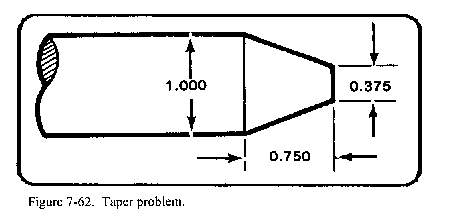
For example, the compound rest setting for the workpiece shown in Figure 7-62 would be calculated in the following manner

Where TPI = taper per inch
| D | = | large diameter, |
| d | = | small diameter, |
| L | = | length of taper |
| angle | = | compound rest setting |
The problem is actually worked out by substituting numerical values for the letter variables:
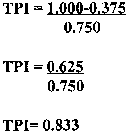
Apply the formula to find the angle by substituting the numerical values for the letter variables:

Using the trig charts in TC 9-515 or any other source of trig charts, the TAN of 0.41650 is found to be 22º37'. This angle is referred to as 22 degrees and 37 minutes.
To machine the taper shown in Figure 7-62, the compound rest will be set at 22°37 '. Since the base of the compound rest is not calibrated in minutes, the operator will set the base to an approximate degree reading, make trial cuts, take measurements, and readjust as necessary to obtain the desired angle of taper. The included angle of the workpiece is double that of the tangent of angle (compound rest setting). In this case, the double of 22°37' would equal the included angle of 45°14'.
To machine a taper by this method, the tool bit is set on center with the workpiece axis. Turn the compound rest feed handle in a counterclockwise direction to move the compound rest near its rear limit of travel to assure sufficient traverse to complete the taper. Bring the tool bit into position with the workpiece by traversing and cross-feeding the carriage. Lock the carriage to the lathe bed when the tool bit is in position. Cut from right to left, adjusting the depth of cut by moving the cross feed handle and reading the calibrated collar located on the cross feed handle. feed the tool bit by hand-turning the compound rest feed handle in a clockwise direction.
Offsetting the Tailstock
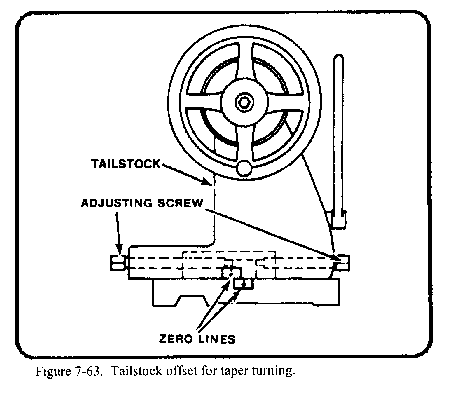
The oldest and probably most used method of taper turning is the offset tailstock method. The tailstock is made in two pieces: the lower piece is fitted to the bed, while the upper part can be adjusted laterally to a given offset by use of adjusting screws and lineup marks (Figure 7-63).
Since the workpiece is mounted between centers, this method of taper turning can only be used for external tapers. The length of the taper is from headstock center to tailstock center, which allows for longer tapers than can be machined using the compound rest or taper attachment methods.
The tool bit travels along a line which is parallel with the ways of the lathe. When the lathe centers are aligned and the workpiece is machined between these centers, the diameter will remain constant from one end of the piece to the other. If the tailstock is offset, as shown in Figure 7-64, the centerline of the workpiece is no longer parallel with the ways; however, the tool bit continues its parallel movement with the ways, resulting in a tapered workpiece. The tailstock may be offset either toward or away from the operator. When the offset is toward the operator, the small end of the workpiece will be at the tailstock with the diameter increasing toward the headstock end.

The offset tailstock method is applicable only to comparatively gradual tapers because the lathe centers, being out of alignment, do not have full bearing on the workpiece. Center holes are likely to wear out of their true positions if the lathe centers are offset too far, causing poor results and possible damage to centers.
The most difficult operation in taper turning by the offset tailstock method is determining the proper distance the tailstock should be moved over to obtain a given taper. Two factors affect the amount the tailstock is offset: the taper desired and the length of the workpiece. If the offset remains constant, workpieces of different lengths, or with different depth center holes, will be machined with different tapers (Figure 7-65).

The formula for calculating the tailstock offset when the taper is given in taper inches per foot (tpf) is as follows

|
Where: Offset |
= |
tailstock offset (in inches) |
|
TPF |
= |
taper (in inches per foot) |
|
L |
= |
length of taper (in feet) measured along the axis of the workpiece |
For example, the amount of offset required to machine a bar 42 inches (3.5 feet) long with a taper of 1/2 inch per foot is calculated as follows:
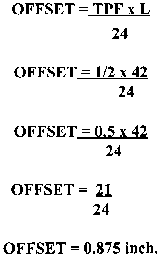
Therefore, the tailstock should be offset 0.875 inch to machine the required taper. The formula for calculating the tailstock offset when the taper is given in TPF is as follows:

|
Where OFFSET |
= |
tailstock offset |
|
TPI |
= |
taper per inch |
|
L |
= |
length of taper in inches |
For example, the amount of offset required to machine a bar 42 inches long with a taper of 0.0416 TPI is calculated as follows:
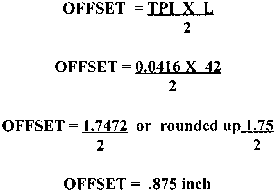
Therefore, the tailstock should be offset 0.875 inch to machine the required taper.
If the workpiece has a short taper in any par of it's length and the TPI or TPF is not given, use the following formula:

Where :
D = Diameter of large end
d = Diameter of small end
L = Total length of workpiece in inches diameter (in inches)
L1 = Length of taper
For example, the amount of tailstock offset required to machine a bar 36 inches (3 feet) in length for a distance of 18 inches (1.5 feet) when the large diameter is 1 3/4 (1 .750) inches and the small diameter is 1 1/2 (1.5) inches is calculated as follows
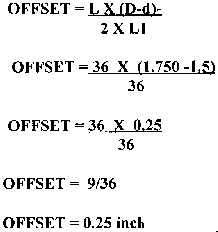
Therefore, the tailstock would be offset (toward the operator) 0.25 inch to machine the required taper.
Metric tapers can also be calculated for taper turning by using the offset tailstock method. Metric tapers are expressed as a ratio of 1 mm per unit of length. Figure 7-66 shows how the work would taper 1 mm in a distance of 20 mm. This taper would then be given as a ratio of 1:20 and would be annotated on small diameter (d) will be 1 mm greater (d + ). Refer to the following formula for calculating the dimensions of a metric taper. If the small diameter (d), the unit length of taper (k), and the total length of taper (1) are known, then the large diameter (D) may be calculated. The large diameter (D) will be equal to the small diameter plus the amount of taper. The amount of taper for the unit length (k) is (d + 1) -(d). Therefore, the amount of taper per millimeter of unit length = (l/k). The total amount of taper will be the taper per millimeter (l/k) multiplied by the total length of taper (l).


For example, to calculate for the large diameter D for a 1:30

taper having a small diameter of 10 mm and a length of 60 mm, do the following:
Since the taper is the ratio 1:30, then (k)= 30, since 30 is the unit of length.

Tailstock offset is calculated as follows:
|
Tailstock offset = |
|

|
D |
= large diameter |
|
d |
= small diameter |
|
I |
= length of taper |
|
L |
= length of the workpiece |
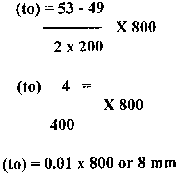
Thus, to determine the tailstock offset in millimeters for the taper in Figure 7-67, substitute the numbers and solve for the offset. Calculate the tailstock offset required to turn a 1:50 taper 200 mm long on a workpiece 800 mm long. The small diameter of the tapered section is 49 mm.
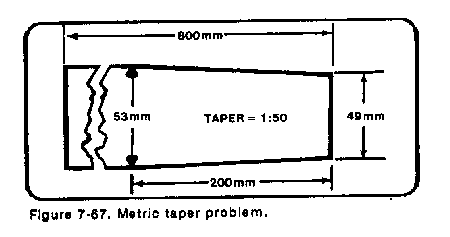

The tailstock would be moved toward the operator 8 mm.
Another important consideration in calculating offset is the distance the lathe centers enter the workpiece. The length of the workpiece (L) should be considered as the distance between the points of the centers for all offset computations.
Therefore, if the centers enter the workpiece 1/8 inch on each end and the length of the workpiece is 18 inches, subtract 1/4 inch from 18 inches and compute the tailstock offset using 17 3/4 inches as the workpiece length (L).
The amount of taper to be cut will govern the distance the top of the tailstock is offset from the centerline of the lathe. The tailstock is adjusted by loosening the clamp nuts, shifting the upper half of the tailstock with the adjusting screws, and then tightening them in place.
There are several methods the operator may use to measure the distance the tailstock has been offset depending upon the accuracy desired (Figure 7-68 ).

One method is to gage the distance the lineup marks on the rear of the tailstock have moved out of alignment. This can be done by using a 6-inch rule placed near the lineup marks or by transferring the distance between the marks to the rule's surface using a pair of dividers.
Another common method uses a rule to check the amount of offset when the tailstock is brought close to the headstock.
Where accuracy is required, the amount of offset may be measured by means of the graduated collar on the cross feed screw. First compute the amount of offset; next, set the tool holder in the tool post so the butt end of the holder faces the tailstock spindle. Using the cross feed, run the tool holder in by hand until the butt end touches the tailstock spindle. The pressure should be just enough to hold a slip of paper placed between the tool holder and the spindle. Next, move the cross slide to bring the tool holder toward you to remove the backlash. The reading on the cross feed micrometer collar may be recorded, or the graduated collar on the cross feed screw may be set at zero. Using either the recorded reading or the zero setting for a starting point, bring the cross slide toward you the distance computed by the offset. Loosen and offset the tailstock until the slip of paper drags when pulled between the tool holder and the spindle. Clamp the tailstock to the lathe bed.
Another and possibly the most precise method of measuring the offset is to use a dial indicator. The indicator is set on the center of the tailstock spindle while the centers are still aligned. A slight loading of the indicator is advised since the first 0.010 or 0.020 inches of movement of the indicator may be inaccurate due to mechanism wear causing fluctuating readings. Load the dial indicators follows: Set the bezel to zero and move tailstock towards the operator the calculated Famount. Then clamp the tailstock to the way.
Whichever method is used to offset the tailstock, the offset must still be checked before starting to cut. Set the dial indicator in the tool post with its spindle just barely touching far right side of the workpiece. Then, rotate the carriage toward the headstock exactly 1 inch and take the reading from the dial indicator. One inch is easily accomplished using the thread chasing dial. It is 1 inch from one number to another.
Alternatively, 1 inch can be drawn out on the workpiece. The dial indicator will indicate the taper for that 1 inch and, if needed, the tailstock can be adjusted as needed to the precise taper desired. If this method of checking the taper is not used, then an extensive trial and error method is necessary.
To cut the taper, start the rough turning at the end which will be the small diameter and feed longitudinally toward the large end (Figure 7-64). The tailstock is offset toward the operator and the feed will be from right to left. The tool bit, a right-hand turning tool bit or a round-nose turning tool bit, will have its cutting edge set exactly on the horizontal centerline of the workpiece, not above center as with straight turning.
Taper Attachment
The taper attachment (Figure 7-69 ) has many features of special value, among which are the following:
-
The lathe centers remain in alignment and the center holes in the work are not distorted.
-
The alignment of the lathe need not be disturbed, thus saving considerable time and effort.
-
Taper boring can be accomplished as easily as taper turning.
-
A much wider range is possible than by the offset method. For example, to machine a 3/4-inch-per-foot taper on the end of a bar 4 feet long would require an offset of 1 1/2 inches, which is beyond the capabilities of a regular lathe but can be accomplished by use of the taper attachment.
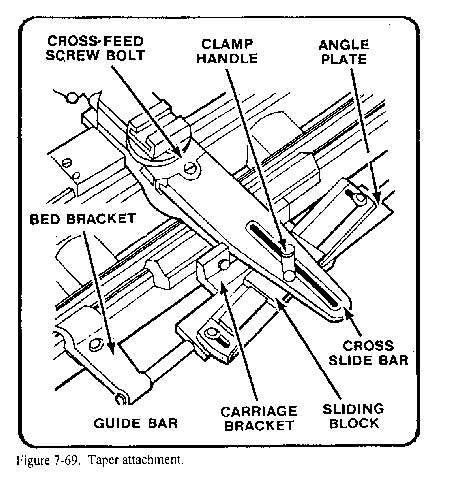
Some engine lathes are equipped with a taper attachment as standard equipment and most lathe manufacturers have a taper attachment available. Taper turning with a taper attachment, although generally limited to a taper of 3 inches per foot and to a set length of 12 to 24 inches, affords the most accurate means for turning or boring tapers. The taper can be set directly on the taper attachment in inches per foot; on some attachments, the taper can be set in degrees as well.
Ordinarily, when the lathe centers are in line, the work is turned straight, because as the carriage feeds along, the tool is always the same distance from the centerline. The purpose of the taper attachment is to make it possible to keep the lathe centers in line, but by freeing the cross slide and then guiding it (and the tool bit) gradually away from the centerline, a taper can be cut or, by guiding it gradually nearer the centerline (Figure 7-70), a taper hole can be bored.

A plain taper attachment for the lathe is illustrated in Figure 7-69. A bed bracket attaches to the lathe bed and keeps the angle plate from moving to the left or the right. The carriage bracket moves along the underside of the angle plate in a dovetail and keeps the angle plate from moving in or out on the bed bracket. The taper to be cut is set by placing the guide bar, which clamps to the angle plate, at an angle to the ways of the lathe bed. Graduations on one or both ends of the guide bar are used to make this adjustment. A sliding block which rides on a dovetail on the upper surface of the guide bar is secured during the machining operation to the cross slide bar of the carriage, with the cross feed screw of the carriage being disconnected. Therefore, as the carriage is traversed during the feeding operation, the cross slide bar follows the guide bar, moving at the predetermined angle from the ways of the bed to cut the taper. It is not necessary to remove the taper attachment when straight turning is desired. The guide bar can be set parallel to the ways, or the clamp handle can be released permitting the sliding block to move without affecting the cross slide bar, and the cross feed screw can be reengaged to permit power cross feed and control of the cross slide from the apron of the carriage.
Modern lathes often use a telescopic taper attachment. This attachment allows for using the cross feed, and set up is a bit faster than using a standard taper attachment. To use the telescopic attachment, first set the tool bit for the required diameter of the work and engage the attachment by tightening the binding screws, the location and number of which depend upon the design of the attachment. The purpose of the binding screws is to bind the cross slide so it may be moved only by turning the cross feed handle, or, when loosened, to free the cross slide for use with the taper attachment. To change back to straight turning with the telescopic attachment, it is necessary only to loosen the binding screws.
When cutting a taper using the taper attachment, the direction of feed should be from the intended small diameter toward the intended large diameter. Cutting in this manner, the depth of cut will decrease as the tool bit passes along the workpiece surface and will assist the operator in preventing possible damage to the tool bit, workpiece, and lathe by forcing too deep a cut.
The length of the taper the guide bar will allow is usually not over 12 to 24 inches, depending on the size of the lathe. It is possible to machine a taper longer than the guide bar allows by moving the attachment after a portion of the desired taper length has been machined; then the remainder of the taper can be cut. However, this operation requires experience.
If a plain standard taper attachment is being used, remove the binding screw in the cross slide and set the compound rest perpendicular to the ways. Use the compound rest graduated collar for depth adjustments.
When using the taper attachment, there may be a certain amount of "lost motion" (backlash) which must be eliminated or serious problems will result. In every slide and every freely revolving screw there is a certain amount of lost motion which is very noticeable if the parts are worn. Care must be taken to remove lost motion before proceeding to cut or the workpiece will be turned or bored straight for a short distance before the taper attachment begins to work. To take up lost motion when turning tapers, run the carriage back toward the dead center as far as possible, then feed forward by hand to the end of the workpiece where the power feed is engaged to finish the cut. This procedure must be repeated for every cut.
The best way to bore a taper with a lathe is to use the taper attachment. Backlash must be removed when tapers are being bored with the taper attachment, otherwise the hole will be bored straight for a distance before the taper starts. Two important factors to consider: the boring tool must be set exactly on center with the workpiece axis, and it must be small enough in size to pass through the hole without rubbing at the small diameter. A violation of either of these factors will result in a poorly formed, inaccurate taper or damage to the tool and workpiece. The clearance of the cutter bit shank and boring tool bar must be determined for the smaller diameter of the taper. Taper boring is accomplished in the same manner as taper turning.
To set up the lathe attachment for turning a taper, the proper TPF must be calculated and the taper attachment set-over must be checked with a dial indicator prior to cutting. Calculate the taper per foot by using the formula:

|
|
| D = large diameter (in inches), |
| d = small diameter (in inches), |
| L = length of taper |
After the TPF is determined, the approximate angle can be set on the graduated TPF scale of the taper attachment. Use a dial indicator and a test bar to set up for the exact taper. Check the taper in the same manner as cutting the taper by allowing for backlash and moving the dial indicator along the test bar from the tailstock end of the head stock end. Check the TPI by using the thread-chasing dial, or using layout lines of 1-inch size, and multiply by 12 to check the TPF. Make any adjustments needed, set up the work to be tapered, and take a trial cut. After checking the trial cut and making final adjustments, continue to cut the taper to required dimensions as in straight turning. Some lathes are set up in metric measurement instead of inch measurement. The taper attachment has a scale graduated in degrees, and the guide bar can be set over for the angle of the desired taper. If the angle of the taper is not given, use the following formula to determine the amount of the guide bar set over:
|
Guide Bar Set Over (in millimeters) = |
 |
D = large diameter of taper (mm)
d = small diameter of taper (mm)
I = length of taper (mm)
L = length of guide bar (mm)
Reference lines must be marked on the guide bar an equal distance from the center for best results.
A metric dial indicator can be used to measure the guide bar set over, or the values can be changed to inch values and an inch dial indicator used.
Checking Tapers for Accuracy
Tapers must be checked for uniformity after cutting a trial cut. Lay a good straight edge along the length of the taper and look for any deviation of the angle or surface. Deviation is caused by backlash or a lathe with loose or worn parts. A bored taper may be checked with a plug gage (Figure 7-71) by marking the gage with chalk or Prussian blue pigment. Insert the gage into the taper and turn it one revolution. If the marking on the gage has been rubbed evenly, the angle of taper is correct. The angle of taper must be increased when there is not enough contact at the small end of the plug gage, and it must be decreased when there is not enough contact at the large end of the gage. After the correct taper has been obtained but the gage does not enter the workpiece far enough, additional cuts must be taken to increase the diameter of the bore.
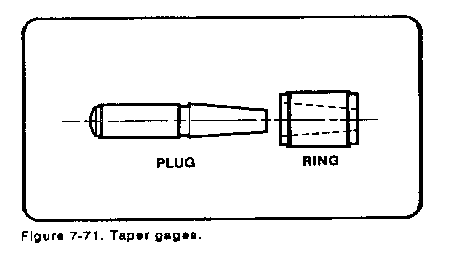
An external taper may be checked with a ring gage (Figure 7-71). This is achieved by the same method as for checking internal tapers, except that the workpiece will be marked with the chalk or Prussian blue pigment rather than the gage. Also, the angle of taper must be decreased when there is not enough contact at the small end of the ring gage and it must be increased when there is not enough contact at the large end of the gage. If no gage is available, the workpiece should be tested in the hole it is to fit. When even contact has been obtained, but the tapered portion does not enter the gage or hole far enough, the diameter of the piece is too large and must be decreased by additional depth of cut
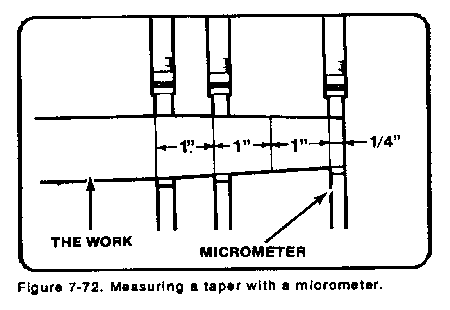
Another good method of checking external tapers is to scribe lines on the workpiece 1 inch apart (Figure 7-72); then, take measurements with an outside micrometer. Subtracting the small reading from the large reading will give the taper per inch.
Duplicating a Tapered Piece
When the taper on a piece of work is to be duplicated and the original piece is available, it may be placed between centers on the lathe and checked with a dial indicator mounted in the tool post.. When the setting is correct, the dial indicator reading will remain constant when moved along the length of taper.
This same method can be used on workpieces without centers provided one end of the workpiece can be mounted and held securely on center in the headstock of the lathe. For example, a lathe center could be mounted in the lathe spindle by use of the spindle sleeve, or a partially tapered workpiece could be held by the nontapered portion mounted in a collet or a chuck. Using either of these two methods of holding the work, the operator could use only the compound rest or the taper attachment for determining and machining the tapers.
Standard Tapers
There are various standard tapers in commercial use, the most common ones being the Morse tapers, the Brown and Sharpe tapers, the American Standard Machine tapers, the Jarno tapers, and the Standard taper pins.
Morse tapers are used on a variety of tool shanks, and exclusively on the shanks of twist drills. The taper for different numbers of Morse tapers is slightly different, but is approximately 5/8 inch per foot in most cases. Dimensions for Morse tapers are given in Machinist Table 7-4 in Appendix A.
Brown and Sharpe tapers are used for taper shanks on tools such as end mills and reamers. The taper is approximately ½ inch per foot for all sizes except for taper No 10, where the taper is 0.5161 inch per foot.
The American Standard machine tapers are composed of a self-holding series and a steep taper series. The self-holding taper series consists of 22 sizes which are given in Machinist Table 7-5 in Appendix A. The name "self-holding" has been applied where the angle of the taper is only 2° or 3° and the shank of the tool is so firmly seated in its socket that there is considerable frictional resistance to any force tending to. turn or rotate the tool in the holder. The self-holding tapers are composed of selected tapers from the Morse, the Brown and Sharpe, and the ¾-inch-per foot machine taper series. The smaller sizes of self-holding tapered shanks are provided with a tang to drive the cutting tool. Larger sizes employ a tang drive with the shank held by a key, or a key drive with the shank held with a draw bolt. The steep machine tapers consist of a preferred series and an intermediate series as given in Machinist Table 7-6 in Appendix A. A steep taper is defined as a taper having an angle large enough to ensure the easy or self-releasing feature. Steep tapers have a 3 ½-inch taper per foot and are used mainly for aligning milling machine arbors and spindles, and on some lathe spindles and their accessories.
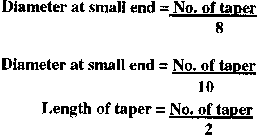
The Jarno taper is based on such simple formulas that practically no calculations are required when the number of taper is known. The taper per foot of all Jarno tapers is 0.600 inch per foot. The diameter at the large end is as many eighths, the diameter at the small end is as many tenths, and the length as many half-inches as indicated by the number of the taper. For example: A No 7 Jarno taper is 7/8 inch in diameter at the large end; 7/10 or 0.7 inch in diameter at the small end; and 7/2, or 3 ½ inches long. Therefore, formulas for these dimensions would read:
The Jarno taper is used on various machine tools, especially profiling machines and die-sinking machines. It has also been used for the headstock and tailstock spindles on some lathes.
The Standard taper pins are used for positioning and holding parts together and have a ¼-inch taper per foot. Standard sizes in these pins range from No 7/0 to No 10 and are given in Machinist Table 7-7 in Appendix A. The tapered holes used in conjunction with the tapered pins utilize the processes of step-drilling and taper reaming.
To preserve the accuracy and efficiency of tapers (shanks and holes), they must be kept free from dirt, chips, nicks, or burrs. The most important thing in regard to tapers is to keep them clean. The next most important thing is to remove all oil by wiping the tapered surfaces with a soft, dry cloth before use, because an oily taper will not hold.
SCREW THREAD CUTTING
Screw threads are cut with the lathe for accuracy and for versatility. Both inch and metric screw threads can be cut using the lathe. A thread is a uniform helical groove cut inside of a cylindrical workpiece, or on the outside of a tube or shaft. Cutting threads by using the lathe requires a thorough knowledge of the different principles of threads and procedures of cutting. Hand coordination, lathe mechanisms, and cutting tool angles are all interrelated during the thread cutting process. Before attempting to cut threads on the lathe a machine operator must have a thorough knowledge of the principles, terminology and uses of threads.
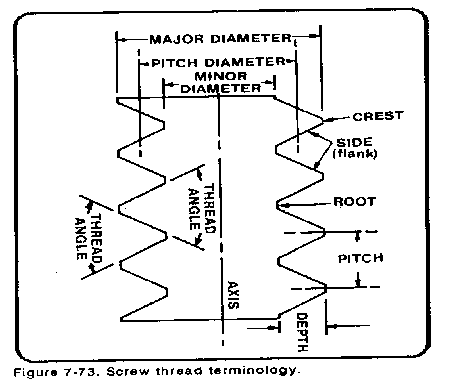
Screw Thread Terminology
The common terms and definitions below are used in screw thread work and will be used in discussing threads and thread cutting.
-
External or male thread is a thread on the outside of a cylinder or cone.
-
Internal or female thread is a thread on the inside of a hollow cylinder or bore.
-
Pitch is the distance from a given point on one thread to a similar point on a thread next to it, measured parallel to the axis of the cylinder. The pitch in inches is equal to one divided by the number of threads per inch.
-
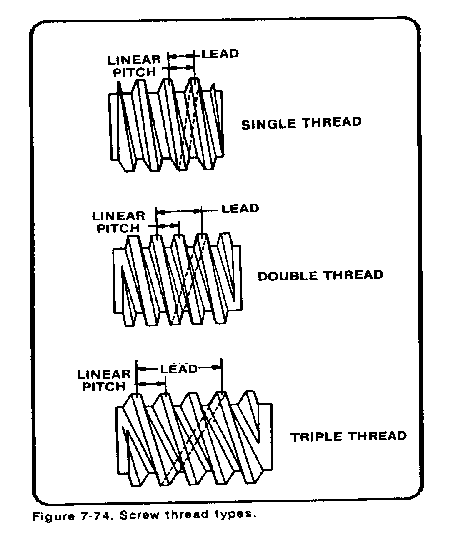
Lead is the distance a screw thread advances axially in one complete revolution. On a single-thread screw, the lead is equal to the pitch. On a double-thread screw, the lead is equal to twice the pitch, and on a triple-thread screw, the lead is equal to three times the pitch (Figure 7-74).
-
Crest (also called "flat") is the top or outer surface of the thread joining the two sides.
-
Root is the bottom or inner surface joining the sides of two adjacent threads.
-
Side is the surface which connects the crest and the root (also called the flank).
-
Angle of the thread is the angle formed by the intersection of the two sides of the threaded groove.
-
Depth is the distance between the crest and root of a thread, measured perpendicular to the axis.
-
Major diameter is the largest diameter of a screw thread.
-
Minor diameter is the smallest diameter of a screw thread.
-
Pitch diameter is the diameter of an imaginary cylinder formed where the width of the groove is equal to one-half of the pitch. This is the critical dimension of threading as the fit of the thread is determined by the pitch diameter (Not used for metric threads).
-
Threads per inch is the number of threads per inch may be counted by placing a rule against the threaded parts and counting the number of pitches in 1 inch. A second method is to use the screw pitch gage. This method is especially suitable for checking the finer pitches of screw threads.
-
A single thread is a thread made by cutting one single groove around a rod or inside a hole. Most hardware made, such as nuts and bolts, has single threads. Double threads have two grooves cut around the cylinder. There can be two, three, or four threads cut around the outside or inside of a cylinder. These types of special threads are sometimes called multiple threads.
-
A right-hand thread is a thread in which the bolt or nut must be turned to the right (clockwise) to tighten.
-
A left hand thread is a thread in which the bolt or nut must turn to the left (counterclockwise) to tighten.
-
Thread fit is the way a bolt and nut fit together as to being too loose or too tight.
-
Metric threads are threads that are measured in metric measurement instead of inch measurement.
Screw Thread Forms
The most commonly used screw thread forms are detailed in the following paragraphs. One of the major problems in industry is the lack of a standard form for fastening devices. The screw thread forms that follow attempt to solve this problem; however, there is still more than one standard form being used in each industrial nation. The International Organization for Standardization (IS0) met in 1975 and drew up a standard metric measurement for screw threads, the new IS0 Metric thread Standard (previously known as the Optimum Metric Fastener System). Other thread forms are still in general use today, including the American (National) screw thread form, the square thread, the Acme thread, the Brown and Sharpe 29° worm screw thread, the British Standard Whitworth thread, the Unified thread, and different pipe threads. All of these threads can be cut by using the lathe.
-
The IS0 Metric thread standard is a simple thread system that has threaded sizes ranging in diameter from 1.6 mm to 100 mm (see Machinist Table 7-8 in Appendix A). These metric threads are identified by the capital M, the nominal diameter, and the pitch. For example, a metric thread with an outside diameter of 5 mm and a pitch of 0.8 mm would be given as M 5 x 0.8. The IS0 metric thread standard simplifies thread design, provides for good strong threads, and requires a smaller inventory of screw fasteners than used by other thread forms. This IS0 Metric thread has a 60° included angle and a crest that is 1.25 times the pitch (which is similar to the National thread form). The depth of thread is 0.6134 times the pitch, and the flat on the root of the thread is wider than the crest. The root of the ISO Metric thread is 0.250 times the pitch (Machinist Table 7-9).
-
The American (National) screw thread form is divided into four series, the National Coarse (NC), National Fine (NF), National Special (NS), and National Pipe threads (NPT). 11 series of this thread form have the same shape and proportions. This thread has a 60° included angle. The root and crest are 0.125 times the pitch. This thread form is widely used in industrial applications for fabrication and easy assembly and construction of machine parts. Table 7-9 in Appendix A gives the different values for this thread form.
-
The British Standard Whitworth thread form thread has a 55° thread form in the V-shape. It has rounded crests and roots.
-
The Unified thread form is now used instead of the American (National) thread form. It was designed for interchangeability between manufacturing units in the United States, Canada, and Great Britain. This thread is a combination of the American (National) screw thread form and the British Whitworth screw thread forms. The thread has a 60° angle with a rounded root, while the crest can be rounded or flat. (In the United States, a flat crest is preferred.) The internal thread of the unified form is like the American (National) thread form but is not cut as deep, leaving a crest of one-fourth the pitch instead of one-eighth the pitch. The coarse thread series of the unified system is designated UNC, while the fine thread series is designated UNF. (See Machinist Table 7-9 in Appendix A for thread form and values.
-
The American National 29° Acme was designed to replace the standard square thread, which is difficult to machine using normal taps and machine dies. This thread is a power transmitting type of thread for use in jacks, vises, and feed screws. Machinist Table 7-9 lists the values for Acme threads.
The Brown and Sharpe 29° worm screw thread uses a 29° angle, similar to the Acme thread. The depth is greater and the widths of the crest and root are different (Machinist Table 7-9 in Appendix A). This is a special thread used to mesh with worm gears and to transmit motion between two shafts at right angles to each other that are on separate planes. This thread has a self-locking feature making it useful for winches and steering mechanisms.
-
The square screw thread is a power transmitting thread that is being replaced by the Acme thread. Some vises and lead screws may still be equipped with square threads. Contact areas between the threads are small, causing screws to resist wedging, and friction between the parts is minimal (Machinist Table 7-9 in Appendix A).
-
The spark plug thread (international metric thread type) is a special thread used extensively in Europe, but seen only on some spark plugs in the United States. It has an included angle of 60° with a crest and root that are 0.125 times the depth.
-
Different types of pipe thread forms are in use that have generally the same characteristics but different fits. Consult the Machinery's Handbook or a similar reference for this type of thread.
THREAD FIT AND CLASSIFICATIONS
The Unified and American (National) thread forms designate classifications for fit to ensure that mated threaded parts fit to the tolerances specified. The unified screw thread form specifies several classes of threads which are Classes 1A, 2A, and 3A for screws or external threaded parts, and 1B, 2B, and 3B for nuts or internal threaded parts. Classes 1 A and 1 B are for a loose fit where quick assembly and rapid production are important and shake or play is not objectionable. Classes 2A and 2B provide a small amount of play to prevent galling and seizure in assembly and use, and sufficient clearance for some plating. Classes 2A and 2B are recommended for standard practice in making commercial screws, bolts, and nuts. Classes 3A and 3B have no allowance and 75 percent of the tolerance of Classes 2A and 2B A screw and nut in this class may vary from a fit having no play to one with a small amount of play. Only high grade products are held to Class 3 specifications.
Four distinct classes of screw thread fits between mating threads (as between bolt and nut) have been designated for the American (National) screw thread form. Fit is defined as "the relation between two mating parts with reference to ease of assembly. " These four fits are produced by the application of tolerances which are listed in the standards.
The four fits are described as follows:
-
Class 1 fit is recommended only for screw thread work where clearance between mating parts is essential for rapid assembly and where shake or play is not objectionable.
-
Class 2 fit represents a high quality of thread product and is recommended for the great bulk of interchangeable screw thread work.
-
Class 3 fit represents an exceptionally high quality of commercially threaded product and is recommended only in cases where the high cost of precision tools and continual checking are warranted.
-
Class 4 fit is intended to meet very unusual requirements more exacting than those for which Class 3 is intended. It is a selective fit if initial assembly by hand is required. It is not, as yet, adaptable to quantity production.
Thread Designations
In general, screw thread designations give the screw number (or diameter) first, then the thread per inch. Next is the thread series containing the initial letter of the series, NC (National Coarse), UNF (Unified Fine), NS (National Special), and so forth, followed by the class of fit. If a thread is left-hand, the letters LH follow the fit. An example of designations is as follows:
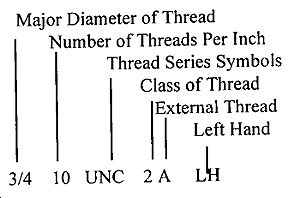
Two samples and explanations of thread designations are as follows:
-
No 12 (0.216) - 24 NC-3. This is a number 12 (0.216-inch diameter) thread, 24 National Coarse threads per inch, and Class 3 ways of designating the fit between parts, including tolerance grades, tolerance positions, and tolerance classes. A simpler fit.
-
1/4-28 UNF-2A LH. This is a l/4-inch diameter thread, 28 Unified Fine threads per inch, Class 2A fit, and left-hand thread.
Metric Thread Fit and Tolerance
The older metric screw thread system has over one hundred different thread sizes and several ways of designating the fit between parts, including tolerance grades, tolerance positions, and tolerance classes. A simple system was devised with the latest ISO Metric thread standard that uses one internal fit and two external fit designations to designate the tolerance (class) of fit. The symbol 6H is used to designate the fit for an internal thread (only the one symbol is used). The two symbols 6g and 5g6g are used to designate the fit for an external thread, 6g being used for general purpose threads and Sg6g used to designate a close fit. A fit between a pair of threaded parts is indicated by the internal thread (nut) tolerance fit designation followed by the external thread (bolt) tolerance fit designation with the two separated by a stroke. An example is M 5 x 0.8-Sg6g/6H, where the nominal or major diameter is 5 mm, the pitch is 0.8 mm, and a close fit is intended for the bolt and nut. Additional information on ISO metric threads and specific fits can be found in any updated engineer's handbook or machinist's handbook.
THREAD CUTTING TOOL BITS
Cutting V-threads with a 60 degrees thread angle is the most common thread cutting operation done on a lathe. V-threads, with the 60 degree angle, are used for metric thread cutting and for American (National) threads and Unified threads. To properly cut V-shaped threads, the single point tool bit must be ground for the exact shape of the thread form, to include the root of the thread (Figure 7-75).
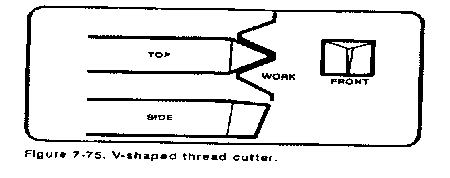
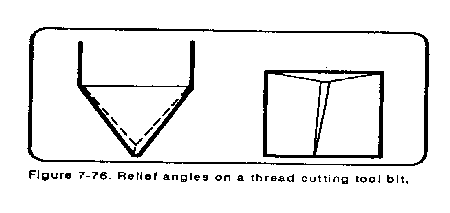
For metric and American (National) thread forms, a flat should be ground at the point of the tool bit (Figure 7-76), perpendicular to the center line of the 600 thread angle. See the thread form table for the appropriate thread to determine the width of the Sat. For unified thread forms, the tip of the tool bit should be ground with a radius formed to fit the size of the root of the thread. Internal unified threads have a flat on the tip of the tool bit. In all threads listed above, the tool bit should be ground with enough side relief angle and enough front clearance angle (Figure 7-76). Figure 7-77 illustrates the correct steps involved in grinding a thread-cutting tool bit.
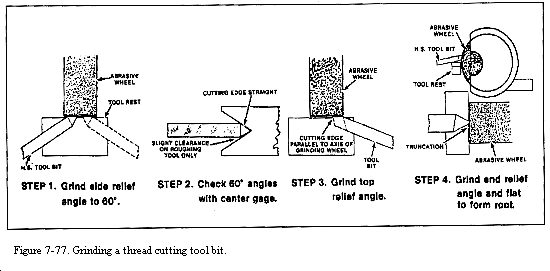
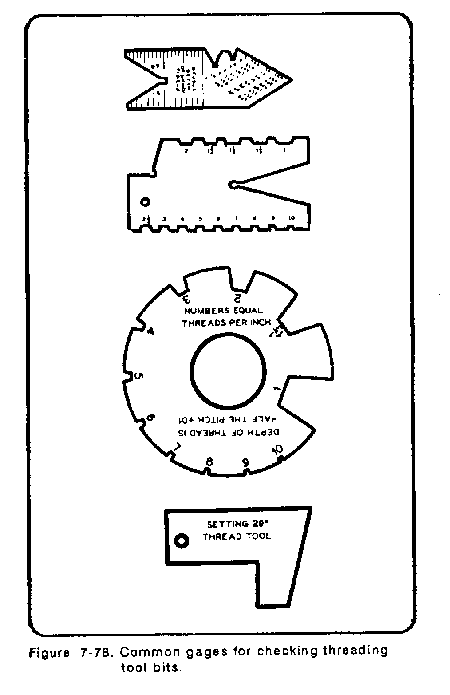
For Acme and 29° worm screw threads, the cutter bit must be ground to form a point angle of 29°. Side clearances must be sufficient to prevent rubbing on threads of steep pitch. The end of the bit is then ground to a flat which agrees with the width of the root for the specific pitch being cut. Thread-cutting tool gages (Figure 7-78) are available to simplify the procedure and make computations unnecessary.
To cut square threads, a special thread-cutter bit is required. Before the square thread-cutter bit can be ground, it is necessary to compute the helix angle of the thread to be cut (Figure 7-79). Compute the helix angle by drawing a line equal in length to the thread circumference at its minor diameter (this is accomplished by multiplying the minor diameter by 3.1416 [pi]). Next, draw a line perpendicular to and at one end of the first line, equal in length to the lead of the thread. If the screw is to have a single thread, the lead will be equal to the pitch. Connect the ends of the angle so formed to obtain the helix angle.

The tool bit should be ground to the helix angle. The clearance angles for the sides should be within the helix angle. Note that the sides are also ground in toward the shank to provide additional clearance.
The end of the tool should be ground flat, the flat being equal to one-half the pitch of the thread to produce equal flats and spaces on the threaded part.
When positioning the thread-cutter bit for use, place it exactly on line horizontally with the axis of the workpiece. This is especially important for thread-cutter bits since a slight variation in the vertical position of the bit will change the thread angle being cut.
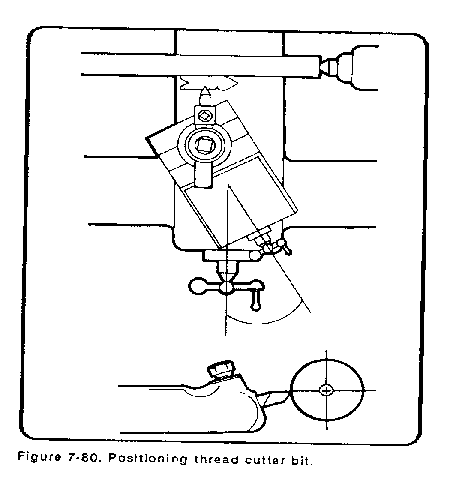
The thread-cutter bit must be positioned so that the centerline of the thread angle ground on the bit is exactly perpendicular to the axis of the workpiece. The easiest way to make this alignment is by use of a center gage. The center gage will permit checking the point angle at the same time as the alignment is being effected. The center gage is placed against the workpiece and the cutter bit is adjusted on the tool post so that its point fits snugly in the 60° angle notch of the center gage (Figure 7-80).
In cutting threads on a lathe, the pitch of the thread or number of threads per inch obtained is determined by the speed ratio of the headstock spindle and the lead screw which drives the carriage. Lathes equipped for thread cutting have gear arrangements for varying the speed of the lead screw. Modern lathes have a quick-change gearbox for varying the lead screw to spindle ratio so that the operator need only follow the instructions on the direction plates of the lathe to set the proper feed to produce the desired number of threads per inch. Once set to a specific number of threads per inch, the spindle speed can be varied depending upon the material being cut and the size of the workpiece without affecting the threads per inch.
The carriage is connected to the lead screw of the lathe for threading operations by engaging the half nut on the carriage apron with the lead screw. A control is available to reverse the direction of the lead screw for left or right-hand threading as desired. Be sure the lead screw turns in the proper direction. Feed the cutter bit from right to left to produce a right-hand thread. Feed the cutter bit from left to right to produce a left-hand thread.
Direction of feed. For cutting standard 60° right-hand threads of the sharp V-type, such as the metric form, the American (National) form, and the Unified form, the tool bit should be moved in at an angle of 29° to the right (Figure 7-81). (Set the angle at 29° to the left for left-hand threads). Cutting threads with the compound rest at this angle allows for the left side of the tool bit to do most of the cutting, thus relieving some strain and producing a free curling chip. The direction is controlled by setting the compound rest at the 29° angle before adjusting the cutter bit perpendicular to the workpiece axis. The depth of cut is then controlled by the compound rest feed handle.

For Acme and 29° worm threads, the compound rest is set at one-half of the included angle (14 1/2°) and is fed in with the compound rest. For square threads, the cutter bit is fed into the workpiece at an angle perpendicular to the workpiece axis.
THREAD CUTTING OPERATIONS
Before cutting threads, turn down the workpiece to the major diameter of the thread to be cut and chamfer the end. Engineering and machinist's handbooks have special tables listing the recommended major and minor diameters for all thread forms. These tables list a minimum and a maximum major diameter for the external threads, and a minimum and maximum minor diameter for internal threads. Machinist Table 7-10 in Appendix A lists the most common screw thread sizes. The difference between the maximum and minimum major diameters varies with different sizes of threads. Coarse threads have a larger difference between the two than fine threads. It is common practice, when machining threads on the lathe, to turn the outside diameter down to the maximum major diameter instead of the minimum major diameter, thus allowing for any error.
The workpiece may be set up in a chuck, in a collet, or between centers. If a long thread is to be cut, a steady rest or other support must be used to help decrease the chance of bending the workpiece. Lathe speed is set for the recommended threading speed (Machinist Lathe Table 7-2 in Appendix A).
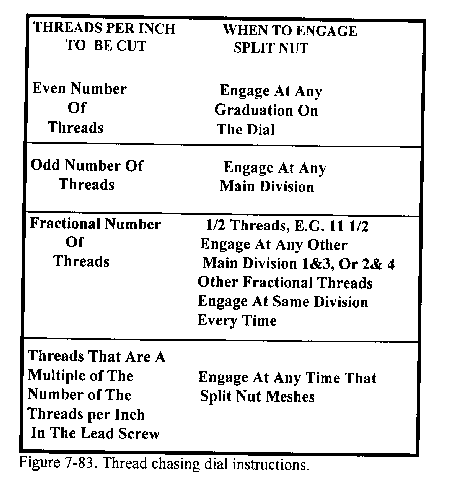
To cut threads, move the threading tool bit into contact with the work and zero the compound rest dial. The threading tool bit must be set at the right end of the work; then, move the tool bit in the first depth of cut by using the graduated collar of the compound rest. Position the carriage half nut lever to engage the half nut to the lead screw in order to start the threading operation. The first cut should be a scratch cut of no more than 0.003 inch so the pitch can be checked. Engaging the half nut with the lead screw causes the carriage to move as the lead screw revolves. Cut the thread by making a series of cuts in which the threading tool follows the original groove for each cut. Use the thread chasing dial, Figure 7-82, to determine when to engage the half nut so that the threading tool will track properly. The dial is attached to the carriage and is driven by means of the lead screw. Follow the directions of the thread chasing dial, Figure 7-83, to determine when to engage the half nut lever.

After making the first pass check for proper pitch of threads by using one of the three methods in Figure 7-84. After each pass of the threading tool bit, the operator must move the threading tool bit out of the threaded groove by backing out the compound rest handle, taking note of the setting. Traverse the carriage back to the start of the thread and move the compound rest dial back to the original setting plus the new depth of cut. At the end of each cut, the half nut lever is usually disengaged and the carriage returned by hand. (The cross slide dial can also be used to move the tool bit in and out, depending on the preference of the operator.)
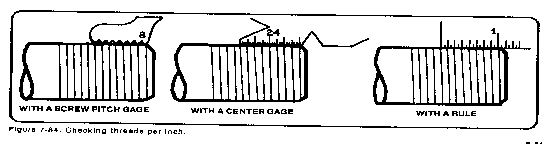
After cutting the first depth of thread, check for the proper pitch of threads by using one of the three methods in Figure 7-84. If the thread pitch is correct as set in the quick-change gearbox, continue to cut the thread to the required depth. This is determined by measuring the pitch diameter and checking the reference table for-the proper pitch diameter limits for the desired fit.
Some lathes are equipped with a thread chasing stop bolted to the carriage which can be set to regulate the depth of cut for each traverse of the cutter bit or can be set to regulate the total depth of cut of the thread.
When the thread is cut the end must be finished in some way. The most common means of finishing the end is with a specially ground or 45 degree angle chanifer cutting bit. To produce a rounded end, a cutter bit with the desired shape should be specially ground for that purpose.
Metric Thread Cutting Operations
Metric threads, are cut one of two ways by using the lathe, designed and equipped for metric measurement or by using a standard inch lathe and converting its operation to cut metric threads. A metric measurement lathe has a quick-change gear box used to set the proper screw pitch in millimeters. An inch-designed lathe must be converted to cut metric threads by switching gears in the lathe headstock according to the directions supplied with each lathe.
Most lathes come equipped with a set of changeable gears for cutting different, or nonstandard screw threads. Follow the directions in the lathe operator manual for setting the proper metric pitch. (A metric data plate may be attached to the lathe headstock.) Most lathes have the capability of quickly attaching these change gears over the existing gears then realigning the gearing. One change gear in needed for the lead screw gear and one for the spindle, or drive gear.
The metric thread diameter and pitch can be easily measured with a metric measuring tool. If there are no metric measuring tools available, the pitch and diameter must be converted from millimeters to inch measurement, and then a inch micrometer and measuring tools can be used to determine the proper pitch and diameter. Millimeters may be converted to inch measurement either by dividing millimeters by 25.4 inches or multiplying by 0.03937 inches.
For example, a thread with a designation M20 x 2.5 6g/6h is read as follows: the M designates the thread is metric. The 20 designates the major diameter in millimeters. The 2.5 designates the linear pitch in millimeters. The 6g/6h designates that a general purpose fit between nut and bolt is intended. Therefore, to machine this metric thread on a inch designed lathe, convert the outside diameter in millimeters to a decimal fraction of an inch and machine the major diameter to the desired diameter measurement. Convert the linear pitch in millimeters, to threads per inch by dividing the linear pitch of 2.5 by 25.4 to get the threads per inch (10.16 TPI).
Now. a 8-13 TPI thread micrometer can be used to measure the pitch diameter for this metric thread.
To sum up how to convert metric threads to inch measurement:
-
Convert major diameter from millimeters to inch measure.
-
Convert pitch and pitch diameter to inch measure.
-
Set quick change gears according to instructions.
Set up the lathe for thread cutting as in the preceding paragraphs on screw thread cutting. Take a light trial cut and check that the threads are of the correct pitch using a metric screw pitch gage. At the end of this trial cut, and any cut when metric threading, turn off the lathe and back out the tool bit from the workpiece without disengaging the half-nut-lever. Never disengage the lever until the metric thread is cut to the proper pitch diameter, or the tool bit will have to be realigned and set for chasing into the thread.
After backing the tool bit out from the workpiece, traverse the tool bit back to the starting point by reversing the lathe spindle direction while leaving the half-nut lever engaged. If the correct pitch is being cut, continue to machine the thread to the desired depth.
NOTE: If the tool bit needs to be realigned and chased into the thread due to disengagement, of the half-nut lever or having to remove the piece and start again, then the lathe must be reset for threading. Start the lathe, with the tool bit clear of the workpiece engage the lever. Allow the carriage to travel until the tool bit is opposite any portion of the unfinished thread; and then turn off the lathe, leaving the engaged. Now the tool bit can be set back into a thread groove by advancing the cross slide and reference. Restart the lathe, and the tool bit should follow the groove that was previously cut, as long as the half-nut lever stays engaged.
TAPERED SCREW THREADS
Tapered screw threads or pipe threads can be cut on the lathe by setting the tailstock over or by using a taper attachment. Refer to the references for taper per inch and nominal measurements of tapered thread forms. When cutting a tapered thread, the tool bit should be set at right angles to the axis of the work. Do not set the tool bit at a right angle to the taper of the thread. Check the thread tool bit carefully for clearances before cutting since the bit will not be entering the work at right angles to the tapered workpiece surface.
MEASURING EXTERNAL V-SHAPED SCREW THREADS
The fit of the thread is determined by its pitch diameter. The pitch diameter is the diameter of the thread at an imaginary point on the thread where the width of the space and the width of the thread are equal. The fact that the mating parts bear on this point or angle of the thread, and not on the top of it, makes the pitch diameter an important dimension to use in measuring screw threads.
The thread micrometer (Figure 7-85) is an instrument used to gage the thread on the pitch diameter. The anvil is V-Shaped to fit over the V-thread. The spindle, or movable point, is cone-shaped (pointed to a V) to fit between the threads. Since the anvil and spindle both contact the sides of the threads, the pitch diameter is gaged and the reading is given on the sleeve and spindle where it can be read by the operator.
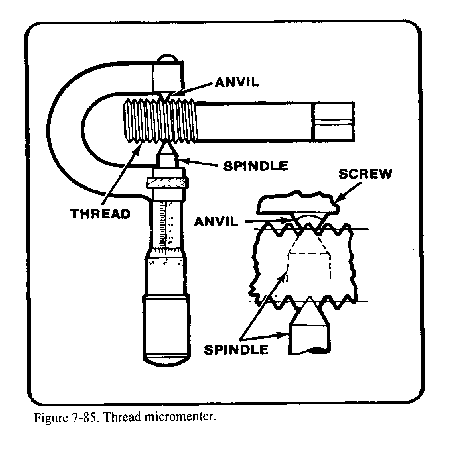
Thread micrometers are marked on the frame to specify the pitch diameters which the micrometer is used to measure. One will be marked, for instance, to measure from 8 to 13 threads per inch, while others are marked 14 to 20, 22 to 30, or 32 to 40; metric thread micrometers are also available in different sizes.
The procedure in checking the thread is first to select the proper micrometer, then calculate or select from a table of threads the correct pitch diameter of the screw. Lastly, fit the thread into the micrometer and take the reading.
The 3-wire method is another method of measuring the pitch diameter for American National (60 degree) and Unified threads. It is considered the "best" method for extremely accurate measurement. Appendix A shows three wires of correct diameter placed in threads with the micrometer measuring over them. The pitch diameter can be found by subtracting the wire constant from the measured distance over the wires. It can be readily seen that this method is dependent on the use of the "'best'" wire for the pitch of the thread. The "best" wire is the size of wire which touches the thread at the middle of the sloping sides. in other words, at the pitch diameter. A formula by which the proper size wire may be found is as follows: Divide the constant 0.57735 by the number of threads per inch to cut. If. for example, 8 threads per inch have been cut, we would calculate 0.57735 8 = 0.072. The diameter of wire to use for measuring an 8-pitch thread is 0.072.
The wires used in the three-wire method should be hardened and lapped steel wires. they, should be three times as accurate as the accuracy desired in measurement of the threads. The Bureau of Standards has specified an accuracy of 0.0002 inch. The suggested procedure for measuring threads is as follows:
After the three wires of equal diameter have been selected by using the above formula, they are positioned in the thread grooves as shown in Appendix A. The anvil and spindle of an ordinary micrometer are then placed against the three wires and the reading is taken. To determine what the reading of the micrometer should be if a thread is the correct finish size. use the following formula (for measuring Unified National Coarse threads): add three times the diameter of the wire to the diameter of the screw; from the sum, subtract the quotient obtained by dividing the constant 1.5155 by the number of threads per inch. Written concisely, the formula is:

|
Where m |
= |
micrometer measurement over wires, |
|
D |
= |
diameter of the thread, |
|
n |
= |
number of threads per inch, |
|
W |
= |
diameter of wire used |
Example: Determine m (measurement over wires) for 1/2 inch, 12-pitch UNC thread. We would proceed to solve as follows:
|
where W |
= |
0.04811 inch |
|
D |
= |
0.500 inch |
|
n |
= |
12 |
| Then m | = |  |
| m | = | (0.500 + 0.14433) - 0.1263 |
|
|
||
| m | = | 0.51803 inch (micrometer measurement) |
When measuring a Unified National Fine thread, the same method and formula are used. Too much pressure should not be applied when measuring over wires.
Metric threads can also be checked by using the three-wire method by using different numerical values in the formula. Three-wire threads of metric dimensions must have a 60° angle for this method.
-
M = PD+ CPD = M-C M = measurement over the wires PD = pitch diameter C = N constant (This is found in Machinist Table 7-11) The "best" wire size can be found by converting from inch to metric, or by using Machinist Table 7-11.
An optical comparator must be used to check the threads if the tolerance desired is less than 0.001 inch (0.02 mm). This type of thread measurement is normally used in industrial shops doing production work.
CUTTING INTERNAL THREADS
Internal threads are cut into nuts and castings in the same general manner as external threads. If a hand tap is not available to cut the internal threads, they must be machined on the lathe.
An internal threading operation will usually follow a boring and drilling operation, thus the machine operator must know drilling and boring procedures before attempting to cut internal threads. The same holder used for boring can be used to hold the tool bit for cutting internal threads. Lathe speed is the same as the speed for external thread cutting.
To prevent rubbing, the clearance of the cutter bit shank and boring tool bar must be greater for threading than for straight boring because of the necessity of moving the bit clear of the threads when returning the bit to the right after each cut.
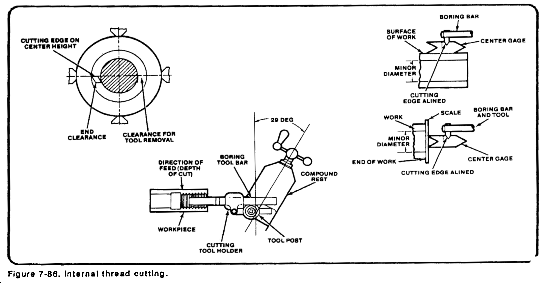
The compound rest should be set at a 29° angle to the saddle so that the cutter bit will feed after each cut toward the operator and to his left.
Although the setup shown in Figure 7-86 would be impractical on extremely large lathes, it allows a degree of safety on common sized machines by having the compound ball crank positioned away from any work holding device that would be in use on the lathe, eliminating the possibility of the operator's hands or the compound rest contacting the revolving spindle and work holding devices.
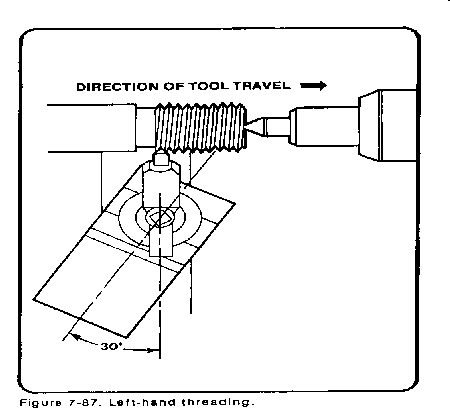
Cutting 60° left-hand threads. A left-hand thread is used for certain applications where a right-hand thread would not be practicable, such as on the left side of a grinder where the nut may loosen due to the rotation of the spindle. Left-hand threads are cut in the same manner as right hand threads, with a few changes. Set the feed direction lever so that the carriage feeds to the right, which will mean that the lead screw revolves opposite the direction used for right-hand threading. Set the compound rest 29° to the left of perpendicular. Cut a groove at the left end of the threaded section, thus providing clearance for starting the cutting tool (see Figure 7-87). Cut from left to right until the proper pitch dimension is achieved.
CUTTING EXTERNAL ACME THREADS
The first step is to grind a threading tool to conform to the 29° included angle of the thread. The tool is first ground to a point, with the sides of the tool forming the 29° included angle (Figure 7-88). This angle can be checked by placing the tool in the slot at the right end of the Acme thread gage.
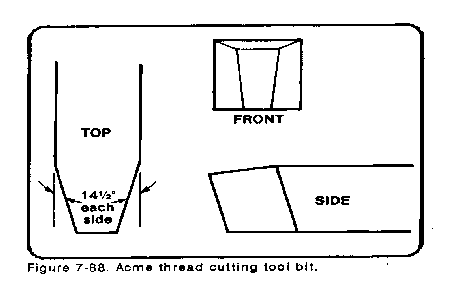
If a gage is not available, the width of the tool bit point may be calculated by the formula:
Width of point = 0.3707P - 0.0052 inch
Where P = Number of threads per inch
Be sure to grind this tool with sufficient side clearance so that it will cut. Depending upon the number of threads per inch to be cut, the point of the tool is ground flat to fit into the slot on the Acme thread gage that is marked with the number of threads per inch the tool is to cut. The size of the flat on the tool point will vary depending upon the thread per inch to be machined.
After grinding the tool, set the compound rest to one-half the included angle of the thread (14 1/2°) to the right of the vertical centerline of the machine (Figure 7-89). Mount the tool in the holder or tool post so that the top of the tool is on the axis or center line of the workpiece. The tool is set square to the work, using the Acme thread gage. This thread is cut using the compound feed. The depth to which you feed the compound rest to obtain total thread depth is determined by the formula given and illustrated in Table 7-9 in Appendix A. The remainder of the Acme thread-cutting operation is the same as the V-threading operation previously described. The compound rest should be fed into the work only 0.002 inch to 0.003 inch per cut until the desired depth of thread is obtained.
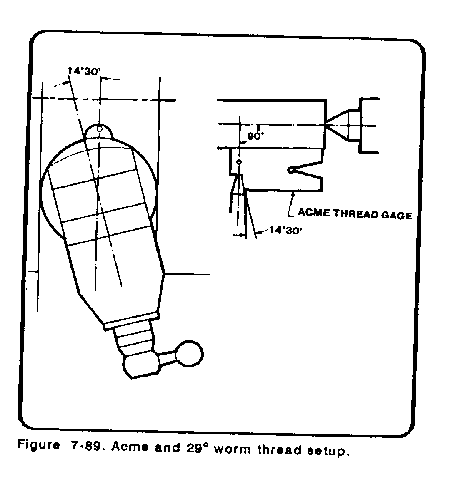
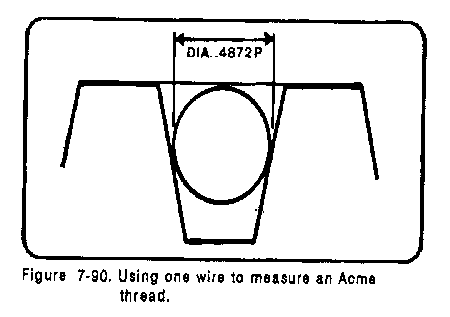
The formulas used to calculate Acme thread depth are in Machinist Table 7-9. The single wire method can be used to measure the accuracy of the thread (Figure 7-90). A single wire or pin of the correct diameter is placed in the threaded groove and measured with a micrometer. The thread is the correct size when the micrometer reading over the wire is the same as the major diameter of the thread and the wire is placed tightly into the thread groove. The diameter of the wire to be used can be calculated by using this formula:
Wire diameter = 0.4872 x pitch
Thus, if 6 threads per inch are being cut, the wire size would be:
0.4872 x 1/6 = 0.081 inch
Cutting the 29° worm screw thread (Brown and Sharpe). The tool bit used to cut 29° worm screw threads will be similar to the Acme threading tool, but slightly longer with a different tip. Use Table 7-9 in Appendix A to calculate the length of the tool bit and tip width. The cutting is done just like cutting an Acme thread.
CUTTING SQUARE THREADS
Because of their design and strength, square threads are used for vise screws, jackscrews, and other devices where maximum transmission of power is needed. All surfaces of the square thread form are square with each other, and the sides are perpendicular to the center axis of the threaded part. The depth, the width of the crest, and root are of equal dimensions. Because the contact areas are relatively small and do not wedge together, friction between matching threads is reduced to a minimum. This fact explains why square threads are used for power transmission.
Before the square thread cutting tool can be ground, it is necessary first to determine the helix angle of the thread. The sides of the tool for cutting the square thread should conform with the helix angle of the thread (Figure 7-79).
For cutting the thread, the cutting edge of the tool should be ground to a width exactly one-half that of the pitch. For cutting the nut, it should be from 0.001 to 0.003 of an inch larger to permit a free fit of the nut on the screw.
The cutting of the square thread form presents some difficulty. Although it is square, this thread, like any other, progresses in the form of a helix, and thus assumes a slight twist. Some operators prefer to produce this thread in two cuts, the first with a narrow tool to the full depth and the second with a tool ground to size. This procedure relieves cutting pressure on the tool nose and may prevent springing the work. The cutting operation for square threads differs from cutting threads previously explained in that the compound rest is set parallel to the axis of the workpiece and feeding is done only with the cross feed. The cross feed is fed only 0.002 inch or 0.003 inch per cut. The finish depth of the thread is determined by the formula.
Depth = 1/2P
The width of the tool point is determined by this formula also and will depend upon the number of threads per inch to be machined. It is measured with a micrometer, as square thread gages are not available.
SPECIAL OPERATIONS ON THE LATHE
KNURLING ON THE LATHE
Knurling is a process of impressing a diamond shaped or straight line pattern into the surface of a workpiece by using specially shaped hardened metal wheels to improve its appearance and to provide a better gripping surface. Straight knurling is often used to increase the workpiece diameter when a press fit is required between two parts.
Holding Devices for Knurling
The setup for knurling can be made between centers or mounted in a solid chuck. Never attempt to knurl by holding the work in a rubber or metal collet chuck, since the great pressures of knurling could damage these devices. It is important to support the work while knurling. If mounting the work between centers, make the center holes as large as possible to allow for the strongest hold. If using a chuck to hold the work, use the tailstock center to support the end of the work. If doing a long knurl, use a steady rest to support the work and keep the piece from springing away from the tool.
Knurling Tools
The knurling tool (Figure 7-10) can be designed differently, but all accomplish the same operation. Two common types of knurling tools are the knuckle joint and revolving head type of knurling tools. The knuckle joint type is equipped with a single pair of rollers that revolve with the work as it is being knurled. The revolving head type of tool is fitted with three pairs of rollers so that the pitch can be changed to a different knurl without having to change the setup. There are two knurl patterns, diamond and straight.
There are three pitches of rollers, coarse, medium, and fine (Figure 7-91).
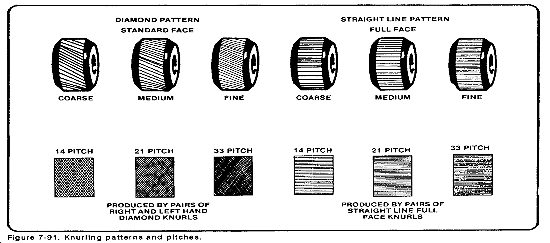
The diamond is the most common pattern and the medium pitch is used most often. The coarse pitch is used for large-diameter work; the fine pitch is used for small-diameter work.
Knurling
The knurling operation is started by determining the location and length of the knurl, and then setting the machine for knurling. A slow speed is needed with a medium feed. Commonly, the speed is set to 60 to 80 RPM, while the feed is best from 0.015 to 0.030 inch per revolution of the spindle. The knurling tool must be set in the tool post with the axis of the knurling head at center height and the face of the knurls parallel with the work surface. Check that the rollers move freely and are in good cutting condition; then oil the knurling tool cutting wheels where they contact the workpiece. Bring the cutting wheels (rollers) up to the surface of the work with approximately 1/2 of the face of the roller in contact with the work.
If the face of the roller is placed in this manner, the initial pressure that is required to start the knurl will be lessened and the knurl may cut smoother. Apply oil generously over the area to be knurled. Start the lathe while forcing the knurls into the work about 0.010 inch. As the impression starts to form, engage the carriage feed lever (Figure 7-92). Observe the knurl for a few revolutions and shut off the machine. Check to see that the knurl is tracking properly, and that it is not on a "double track" (Figure 7-93).
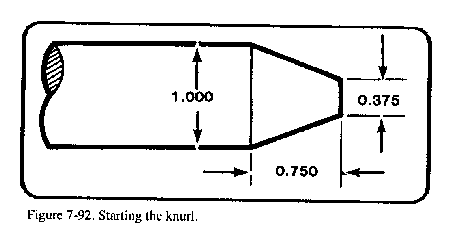

Reset the tool if needed; otherwise, move the carriage and tool back to the starting point and lightly bring the tool back into the previously knurled portion. The rollers will align themselves with the knurled impressions. Force the knurling tool into the work to a depth of about 1/64 inch and simultaneously engage the carriage to feed toward the headstock. Observe the knurling action and allow the tool to knurl to within 1/32 inch of the desired end of cut, and disengage the feed. Hand feed to the point where only one-half of the knurling wheel is off the work, change the feed direction toward the tailstock and force the tool deeper into the work.
Engage the carriage feed and cut back to the starting point. Stop the lathe and check the knurl for completeness. Never allow the knurling tool to feed entirely off the end of the work, or it could cause damage to the work or lathe centers. The knurl is complete when the diamond shape ( or straight knurl) is fully developed. Excessive knurling after the knurl has formed will wear off the full knurl and ruin the work diameter. Move the tool away from the work as the centers. The knurl is complete when the diamond shape (or work revolves and shut off the lathe. Clean the knurl with a brush and then remove any burrs with a file.
Special Knurling Precautions
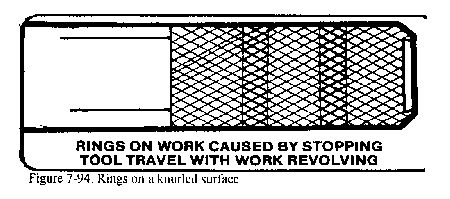
Never stop the carriage while the tool is in contact with the work and the work is still revolving as this will cause wear rings on the work surface (Figure 7-94). Check the operation to ensure that the knurling tool is not forcing the work from the center hole. Keep the work and knurling tool well oiled during the operation. Never allow a brush or rag to come between the rollers and the work or the knurl will be ruined.
DRILLING WITH THE LATHE
Frequently, holes will need to be drilled using the lathe before other internal operations can be completed, such as boring, reaming, and tapping. Although the lathe is not a drilling machine, time and effort are saved by using the lathe for drilling operations instead of changing the work to another machine. Before drilling the end of a workpiece on the lathe, the end to be drilled must be spotted (center-punched) and then center-drilled so that the drill will start properly and be correctly aligned. The headstock and tailstock spindles should be aligned for all drilling, reaming, and spindles should be aligned for drilling, reaming, and tapping operations in order to produce a true hole and avoid damage to the work and the lathe. The purpose for which the hole is to be drilled will determine the proper size drill to use. That is, the drill size must allow sufficient material for tapping, reaming, and boring if such operations are to follow.
The correct drilling speed usually seems too fast due to the fact that the chuck, being so much larger than the drill, influences the operator's judgment. It is therefore advisable to refer to a suitable table to obtain the recommended drilling speeds for various materials, such as Machinist Table 4-2.
Supporting drills in the tailstock
Methods of supporting the twist drill in the tailstock can vary (Figure 7-95). Straight shank drills are usually held in a drill chuck, which is placed in the taper socket of the tailstock spindle. Combination drill and countersinks (center drills), counterbores, reamers, taps, and other small shank cutters can also be supported in this way.
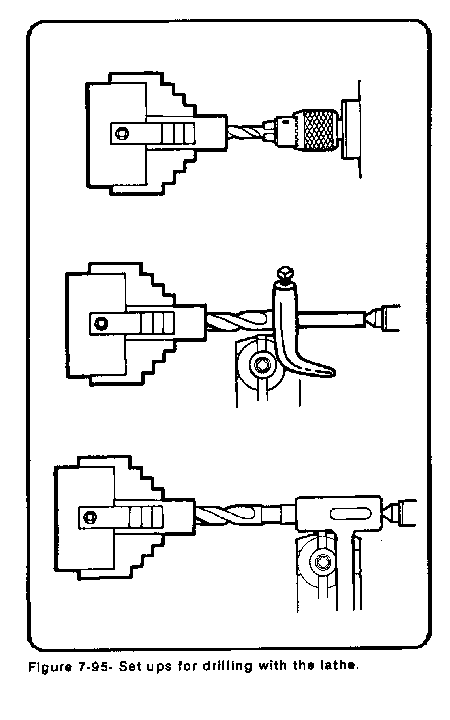
Tapered-shank twist drills may be held directly in the tailstock tapered spindle as long as a good fit exists. If the drill shank is not the correct size, then a drill socket or sleeve may be used in the tailstock spindle.
A twist drill holder is used to support large twist drills with the tailstock center. The drill is inserted into the holder and the tailstock center is placed in the center hole which is located at the rear of the drill holder. The holder will rest on the cross slide or compound rest and must be supported by hand until it is held secure by pressure between the tailstock and headstock. When using this method, never withdraw or loosen the tailstock spindle while the lathe is rotating or the workpiece can be thrown out at the operator. Always stop the machine before attempting to withdraw the twist drill.
Another method of supporting a large twist drill in the tailstock is to fasten a lathe dog to the drill shank and support the rear of the drill with the tailstock center in the center hole in the tang of the drill.
Supporting Drills in the Headstock
The drill can also be held and rotated in the headstock with the work held stationary against the tailstock. Straight shank twist drills are supported in the headstock by a drill chuck or collet which is mounted in the headstock spindle. A universal or independent jaw chuck can also be used to hold and turn twist drills if a headstock drill chuck is not available. Tapered shank twist drills can be mounted in the headstock by using a special adapter, such as a sleeve with an internal taper to hold the tapered drill, while the outside of the sleeve is made to fit into the headstock spindle.
Mounting Work for Drilling
If the work is to be rotated and the twist drill will be fed into the end of the work, the work should be mounted in a chuck, on a faceplate, or in a collet. The center of the hole to be drilled should be accurately marked and punched as described for drilling setups.
Always start holes by using a center drill, since this method will be the most accurate and the most efficient. Center-drill by rotating the spindle at computed drill speed and gently bringing the point of the center drill into the end of the work until the proper depth is reached.
If the twist drill is to be rotated by the headstock spindle and the workpiece is to be supported by a V-center mounted in the tailstock, the work should be carefully positioned by hand and the drill moved lightly into contact with the workpiece before starting the lathe. The workpiece must be well supported during drilling operations to prevent the work from being thrown from the lathe or rotating with the drill.
Drilling Operations
To start the drilling operation, compute the correct RPM for the drill and set the spindle speed accordingly. Ensure the tailstock is clamped down on the lathe ways. The feed is controlled by turning the tailstock handwheel. The graduations on the tailstock spindle are used to determine the depth of cut.
If a large twist drill is used, it should be proceeded by a pilot drill, the diameter of which should be wider than the larger drills web.
Use a suitable cutting fluid while drilling (Machinist Table 4-3). Always withdraw the drill and brush out the chips before attempting to check the depth of the hole. If the drill is wobbling and wiggling in the hole, use a tool holder turned backwards (Figure 7-96) to steady the drill. Always use a drill that is properly ground for the material to be drilled. Use care when feeding the drill into the work to avoid breaking the drill off in the work. The drill should never be removed from the work while the spindle is turning because the drill could be pulled off the tailstock spindle and cause injury or damage.
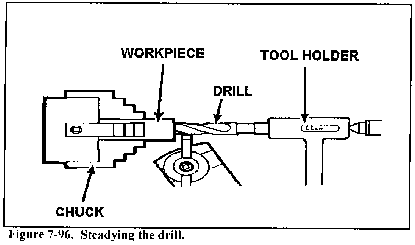
BORING WITH THE LATHE
Boring is the enlarging and truing of a hole by removing material from internal surfaces with a single-point cutter bit. On the lathe, boring is accomplished in either of these two methods:
- Mounting the holder and boring tool bar with cutter bit on the tool post and revolving the workpiece.
- Mounting the workpiece in a fixed position to the carriage and revolving the boring tool bar and cutter bit in a chuck attached to the headstock spindle. (This is a special process and not used in most machine shops).
Mounting Workpiece for Boring
The workpiece may be supported in a chuck or fastened to a faceplate for boring operations depending upon of the material to be machined. When boring is to be performed on the ends of long stock, the workpiece is mounted in a chuck and a steady rest is used to support the right end near the cutter bit. Some boring operations require the use of special chuck-mounted mandrels to hold workpieces that cannot be successfully mounted otherwise.
Purpose for Boring
Boring is necessary in many cases to produce accurate holes. Drilled holes are seldom straight due to imperfections in the material which cause drills to move out of alignment. Therefore, where accuracy is important, drilled holes are usually made undersize and then bored or reamed to the proper dimensions. Boring is also useful in truing large holes in flat material. In this case, the hole is cut undersize using a bandsaw or trepanning tool and is trued to proper dimensions by boring.
Boring Cutter Bit Setup
The cutter bit used for boring is similar to that used for external turning on the lathe. The bit is usually held in a soft or semisoft bar called a boring tool bar. The boring tool bar (Figure 7-11) is supported by a cutting tool holder which fits into the lathe tool post.
Boring tool bars are supplied in several types and sizes for holding different cutter bits. The bit is supported in the boring tool bar at a 90°, 30°, or 45° angle, depending upon the nature of the workpiece being bored. Most general boring is accomplished with a 90° cutter bit. The bit is mounted at a 30° or 45° angle to the axis of the boring tool bar when it is necessary to cut up to the bottom of a hole or finish the side of an internal shoulder. It is desirable that the boring tool bar be as large as possible without interfering with the walls of the hole. The cutter bit should not extend far beyond the boring tool bar and the bit securely in the bar, yet not have the shank-end protrude far from the bar.
The cutter bits used for boring are shaped like left-hand turning and facing cutter bits. Greater attention must be given to the end clearance angle and the back rake angle because of the curvature of the hole (Figure 7-97).
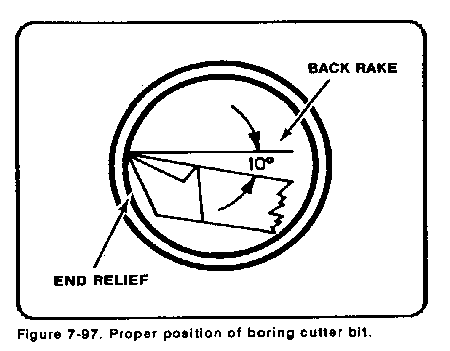
The boring tool bar should be clamped as close to the holder and tool post as possible considering the depth of boring to be done. The bar will have a tendency to spring away from the workpiece if the bar overhangs the tool post too far. If deep boring is to be performed, it will be necessary that the bar be as thick as possible to counteract this springing tendency.
Straight Boring Operation
The cutter bit is positioned for straight boring operations with its cutting edge set slightly above center. Depending on the rigidity of the setup, the boring tool will have a tendency to spring downward as pressure is applied to the cutting edge. By setting the cutter slightly above center, compensation has been made for the downward spring and the cutter will actually be positioned on the exact center of the workpiece during machining operations (Figure 7-98). The cutting edge faces forward for most operations so the lathe can turn in its normal counterclockwise direction. If it becomes necessary to position the cutter bit against the rear wall of the hole for a special operation, a right-hand turning cutter bit is used and the spindle rotation is reversed.
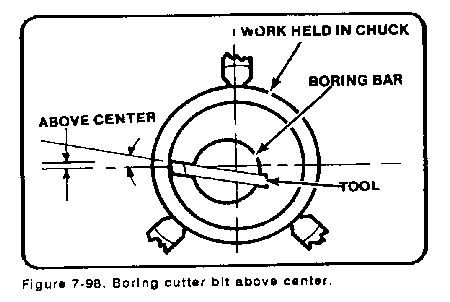
Position the cutter bit so that the cutting edge is immediately to the right of the workpiece and clears the wall of the hole by about 1/16 inch. Traverse the carriage by hand, without starting the lathe, to move the cutter bit and boring tool bar into the hole to the depth of the intended boring and out again to determine whether there is sufficient clearance to prevent the back of the cutter bit and the boring tool bar from rubbing the inside of the hole. When the clearance is satisfactory, position the cutter bit to the right of the workpiece ready for the first cut. Use the micrometer carriage stop to control the depth of tool travel.
The same speeds recommended for straight turning should be used for straight boring. Feeds for boring should be considerably smaller than feeds used for straight turning because there is less rigidity in the setup. Decrease the depth of cut for each pass of the tool bit for the same reason. It is often advisable to feed the cutter bit into the hole to the desired depth and then reverse the feed and let the cutter bit move out of the hole without changing the depth of feed. It is also good practice to take a free cut every several passes to help eliminate bell mouthing of the workpiece. This practice will correct any irregularities caused by the bit or boring tool bar springing because of the pressure applied to the bit.
TAPPING AND HAND DIE THREADING
The lathe can be used as a device to hold and align a tap or hand die to cut internal or external threads quickly for threads that do not require a high degree of accuracy or a fine finish. More information on taps and dies can be found in TM 9-243.
Hand Tapping on the Lathe
Tapping can be done on the lathe by power or by hand. Regardless of the method, the hole must be drilled with the proper sized tap drill and chamfered at the end. The shank end of the tap is supported by the tailstock center. A slight pressure is maintained against the tap to keep its center hole on the center and to help the cutting teeth of the tap engage the work (Figure 7-99).
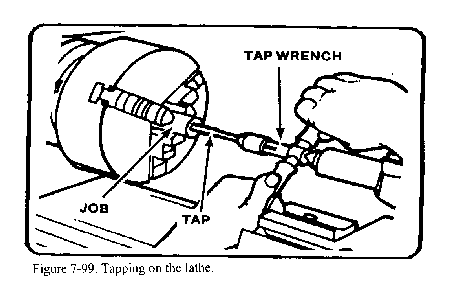
The work will rotate when tapping using lathe power. Use a very slow spindle speed (10 to 30 RPM) and plenty of cutting fluid or coolant. Install a tap and reamer wrench on the end of the tap to keep it from turning. Support the wrench on the compound rest. Power is not recommended for taps under 1/2 inch in diameter or when tapping steel. Ensure that the tap wrench handle contacts the compound rest before engaging power or the end of the handle will whip around and could crush a finger or cause other injury or damage. Do not attempt to start the tap into the hole with the work revolving. Always keep the tap snug in the center hole to prevent the tap from coming out of alignment and ruining the threads.
The setup for hand tapping in a lathe is similar to that used in power tapping. The headstock chuck is held steady and not rotated. The tap is turned by using an adjustable wrench. Lock the lathe gears so that the headstock will not move when using a large tap. Back off the tap frequently when tapping to break the chips and allow for a clean thread.
Hand Die Threading on the Lathe
Die threading on a lathe is very similar to tapping on a lathe, except that the die is aligned perpendicular to the work axis by pressure exerted against the back surface of the die. This pressure can be exerted by means of a drill pad, by using the tailstock spindle, or by using the head of the drill chuck for small dies. Die threading can be done using power or by hand, using the same procedures as tapping. Power can be used to remove the die from the work if the die stock handle is swung to the opposite side and low reverse power is used. It is difficult to cut very coarse threads with a die because of the great amount of force needed to turn the die. It is advisable to open up the die to its full width, rough-cut the threads, and then close up the die and go over the threads for a finished size. Always use a lubricant or coolant for this operation.
REAMING ON THE LATHE
Reamers are used to finish drilled holes or bores quickly and accurately to a specified diameter. When a hole is to be reamed, it must first be drilled or bored to within 0.004 to 0.012 inch of the finished size since the reamer is not designed to remove much material.
Reaming with a Machine Reamer
The hole to be reamed with a machine reamer must be drilled or bored to within 0.012 inch of the finished size so that the machine reamer will only have to remove the cutter bit marks.
The workpiece is mounted in a chuck at the headstock spindle and the reamer is supported by the tailstock in one of the methods described for holding a twist drill in the tailstock.
The lathe speed for machine reaming should be approximately one-half that used for drilling.
Reaming with a Hand Reamer
The hole to be reamed by hand must be within 0.005 inch of the required finished size.
The workpiece is mounted to the headstock spindle in a chuck and the headstock spindle is locked after the piece is accurately setup The hand reamer is mounted in an adjustable tap and reamer wrench and supported with the tailstock center. As the wrench is revolved by hand, the hand reamer is fed into the hole simultaneously by turning the tailstock handwheel.
The reamer should be withdrawn from the hole carefully, turning it in the same direction as when reaming. Never turn a reamer backward. See Machinist Table 4-3 for the proper cutting fluid for reaming. Never use power with a hand reamer or the work could be ruined.
FILING AND POLISHING ON THE LATHE
Filing and polishing are performed on the lathe to remove tool marks, reduce the dimension slightly, or improve the finish.
Filing on the Lathe
Mill files are generally considered best for lathe filing. The bastard cut mill type hand file is used for roughing and the second cut mill-type hand file for the finer class of work. Other types such as the round, half-round, and flat hand files may also be used for finishing irregular shaped workpieces. Never use a file without a handle.
For filing ferrous metals, the lathe spindle speed should be four or five times greater than the rough turning speed. For filing nonferrous metals, the lathe spindle speed should be only two or three times greater than the roughing speed. Too slow a speed may cause the workpiece to be filed out of round, while too high a speed will cause the file to slide over the workpiece, dulling the file and glazing the piece.
NOTE: When filing, file left-handed if at all possible to avoid placing your arm over the revolving chuck or lathe dog.
The file is held at an angle of about 10° to the right and moved with a slow sliding motion from left to right so that the teeth will have a shearing action (Figure 7-100). The direction of stroke and angle should never be the opposite, as this will cause chatter marks on the piece. The file should be passed slowly over the workpiece so that the piece will have made several revolutions before the stroke is completed. The pressure exerted on the file with the hands should be less than when filing at the bench. Since there are less teeth in contact with the workpiece, the file must be cleaned frequently to avoid scratching.
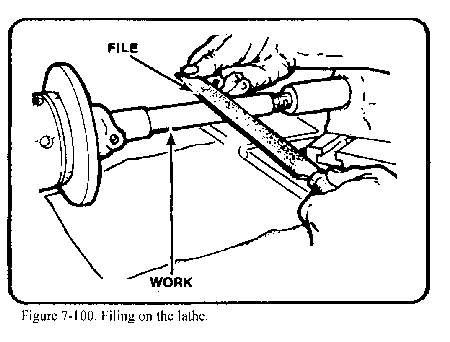
Since filing should be used for little more than to remove tool marks from the workpiece, only 0.002 to 0.005 inch should be left for the filing operation.
Polishing on the Lathe
Polishing with either abrasive cloth or abrasive paper is desirable to improve the surface finish after filing. Emery abrasive cloth is best for ferrous metals while abrasive paper often gives better results on nonferrous materials. The most effective speed for polishing with ordinary abrasives is approximately 5,000 feet per minute. Since most lathes are not capable of a speed this great for an average size workpiece, it is necessary to select as high a speed as conditions will permit.
In most cases the abrasive cloth or paper is held directly in the hand and applied to the workpiece, although it may be tacked over a piece of wood and used in the same manner as a file. Improvised clamps may also be used to polish plain round work.
Since polishing will slightly reduce the dimensions of the workpiece, 0.00025 to 0.0005 inch should be allowed for this operation. Figure 7-101 shows how to hold the abrasive strip when polishing. Note that the ends of the strip are separated. This prevents the strip from grabbing and winding around the work, which could pull the operator's hand into the work. Move the polishing strip slowly back and forth to prevent material building up on the strip which causes polishing rings to form on the work. To produce a bright surface, polish the work dry. To produce a dull satin finish, apply oil as the polishing operation is in progress.
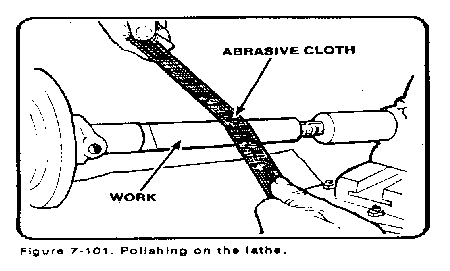
ECCENTRIC WORK ON THE LATHE
Eccentric work is work that is turned off center, or not on the normal center axis. An engine crankshaft is a good example of an eccentric workpiece. Crankshafts normally have a main center axis, called a main journal, and offset axes, which produce the throw and the eccentric diameters of the mechanism. An eccentric shaft may have two or more diameters and several different center axes. The amount of eccentricity, or half of the throw, is the linear distance that a set of center holes has been offset from the normal center axis of the workpiece. Eccentric turning on the lathe is used for the following eccentric turning situations:
When the throw is large enough to allow all centers to be located on the workpiece at the same time.
When the throw is too small to allow all centers to fit into the end of a workpiece at the same time. (The center drilled holes are too large.)
When the throw is so great that all centers cannot be located on the work, or in other words, a throw larger than the largest diameter of the workpiece. (This type of crank is usually made in separate pieces and connected together, since the cost of wasted material would be too great if constructed from one piece on the lathe).
Turning an Eccentric with Center Holes
Before an eccentric workpiece can be machined, it is necessary to center-drill both ends of the workpiece, including the offset centers. If the workpiece is large enough to position all center axes on the work at the same time, the machining operation will be simple and easy.
-
First determine the stock required by adding the throws plus 1/8 inch for machining (Figure 7-102).
-
Face the work to length in a chuck.
-
Remove the piece and apply layout dye to both ends.
-
Mount the work in a V- block and, using a surface plate and venire height scriber, lay out the normal center axis and the offset center axes on both ends.
-
Accurately prick punch the intended centers, check for accuracy, and then enlarge the punch marks with a center punch.
-
Center- drill both sets of center punch marks by using a milling machine, a drilling machine, or the four-jaw independent chuck of the lathe with a dial indicator to line up the centers.
-
Mount the work in the lathe between centers and turn the largest diameter first. If all diameters are the same, turn the middle diameter journal first.
-
After turning the center journal down to the required diameter, remount the work in an offset center hole and machine the throw diameter to the finished size.
-
Accurately prick punch the intended centers, check for accuracy, and then enlarge the punch marks with a center punch.
-
Center- drill both sets of center punch marks by using a milling machine, a drilling machine, or the four-jaw independent chuck of the lathe with a dial indicator to line up the centers.
-
Mount the work in the lathe between centers and turn the largest diameter first. If all diameters are the same, turn the middle diameter journal first.
-
After turning the center journal down to the required diameter, remount the work in an offset center hole and machine the throw diameter to the finished size.
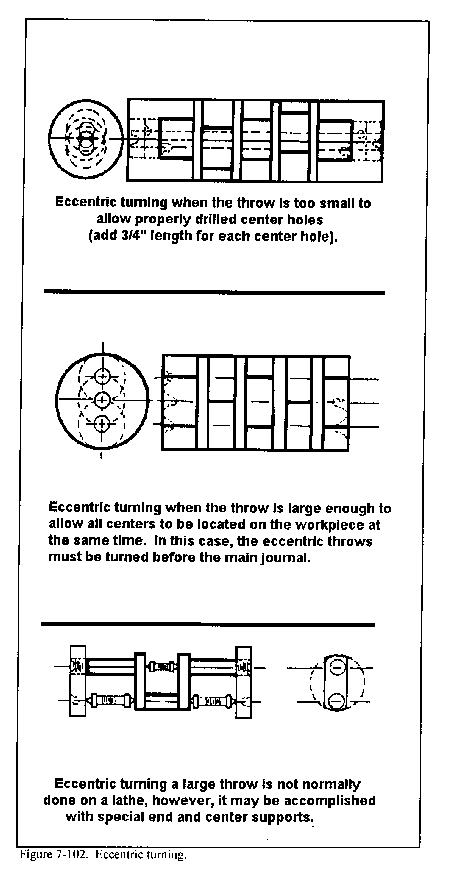
Additional throws are machined in the same manner. Throw positions may be started by cutting with a parting tool to establish the shoulders, which may aid the turning operation. The tool bit selected will depend on the material to be machined and on the depth of cut desired.
Turning an Eccentric with Close Center Holes
If turning an eccentric that has the different centers placed too close together, a different procedure should be used. Cut the stock 3/4 inch oversized and just face both ends to clean up the saw cuts Lay out and center-drill the normal. center axis and turn down those diameters on the center axis with the work mounted between centers. Remove the work and remount into a chuck. Face both ends to the required length and center-drill the offset centers. Remount the work between these centers and machine the eccentric diameters to size. For eccentric work that has a limited distance between each center, this method is safer than trying to use a very shallow center-drilled hole to hold the work between centers (Figure 7-102).
Turning an Eccentric Using Throw Plates
If the lathe is to be used to turn a crank with a great throw, or a throw that is greater than normally machined on a lathe (Figure 7-102), special throw plates must be fabricated to hold the ends of the work while turning. The special throw plates will be used as support blocks to enable the offset center holes to be machined into the throw plates and allow for eccentric turning. eccentric turning, it is not recommended for normal lathe operations. Special crankshaft turning and grinding equipment is available for this type of machining.
RECESSING DRILLED AND BORED HOLES
General
Recessing, sometimes called channeling or cambering, is the process of cutting a groove inside of a drilled, bored, or reamed hole. Recesses (Figure 7-103) are usually machined to provide room for the tool runout needed for subsequent operations such as internal threading.

A boring bar and holder may be used as a recessing tool, since recessing tools have the same tool angles and are similar in shape to boring tools. A high-speed steel cutting tool bit, ground with a square nose, makes a satisfactory tool for cutting small chambers (Figure 7-103). The sides of the tool bit taper in from the cutting edge so that the nose of the tool is the widest part. The tool bit must extend from the holder a distance slightly greater than the depth of the chamber to prevent the holder from rubbing the bore of the work.
Machining a Recess
To cut a recess, set up the lathe as in a boring operation. Reference the face of the tool bit to the face of the work; then move the tool bit forward the required distance to the recess by using the micrometer stop or by using the compound rest graduated collar. The compound rest must be set parallel with the ways of the bed for this method. Add the width of the tool bit into the measurement or the recess will not be cut correctly. Position A (Figure 7-103) is the tool aligning to the work, position B is set over to the front shoulder of the recess, and position C is the set over to the back of the recess. Use the cross slide graduated collar to measure the distance to move the tool bit toward the operator, inside of the hole. Spindle speed may have to be reduced due to the shape of the tool bit causing chatter on the work. After cutting the recess, use inside calipers to check the diameter.
LATHE TOOL POST GRINDER
General
The tool post grinder is a portable grinding machine that can be mounted on the compound rest of a lathe in place of the tool post. It can be used to machine work that is too hard to cut by ordinary means or to machine work that requires a very fine finish. Figure 7-29 shows a typical tool post grinder. The grinder must be set on center, as shown in Figure 7-104. The centering holes located on the spindle shaft are used for this purpose. The grinding wheel takes the place of a lathe cutting tool. It can perform most of the operations that a cutting tool is capable of performing. cylindrical, tapered, and internal surfaces can be ground with the tool post grinder. Very small grinding wheels are mounted on tapered shafts known as quills to grind internal surfaces.
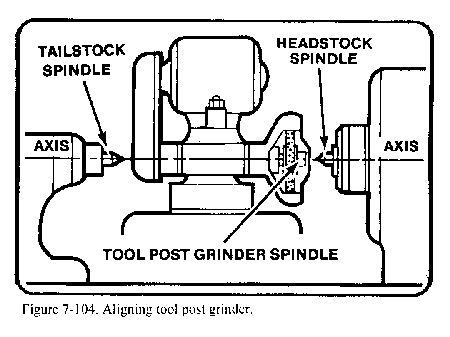
Selection of Grinding Wheels and Speeds
The grinding wheel speed is changed by using various sizes of pulleys on the motor and spindle shafts. An instruction plate on the grinder gives both the diameter of the pulleys required to obtain a given speed and the maximum safe speed for grinding wheels of various diameters. Grinding wheels are safe for operation at a speed just below the highest recommended speed. A higher than recommended speed may cause the wheel to disintegrate. For this reason, wheel guards are furnished with the tool post grinder to protect against injury. Always check the pulley combinations given on the instruction plate of the grinder when you mount a wheel. Be sure that the combination is not reversed, because this may cause the wheel to run at a speed far in excess of that recommended. During all grinding operations, wear goggles to protect your eyes from flying abrasive material.
Dressing the Grinding Wheel
The grinding wheel must be dressed and trued. Use a diamond wheel dresser to dress and true the wheel. The dresser is held in a holder that is clamped to the drive plate. Set the point of the diamond at center height and at a 10° to 15° angle in the direction of the grinding wheel rotation. The 10° to 15° angle prevents the diamond from gouging the wheel. Lock the lathe spindle by placing the spindle speed control lever in the low RPM position.
NOTE: The lathe spindle does not revolve when you are dressing the grinding wheel.
Remove the diamond dresser holder as soon as the dressing operation is completed. Bring the grinding wheel in contact with the diamond by carefully feeding the cross slide by hand. Move the wheel clear of the diamond and make a cut by means of the cross slide. The maximum depth of cut is 0.002 inch. Move the wheel slowly by hand back and forth over the point of the diamond. Move the carriage if the face of the wheel is parallel to the way of the lathe. Move the compound rest if the face of the wheel is at an angle. Make the final depth of cut of 0.0005 inch with a slow, even feed to obtain a good wheel finish.
Before you begin the grinding operation, cover the ways with a heavy piece of paper or use a shallow pan of water placed on the ways to collect the grinding dust that will accumulate from the grinding. This is to ensure none of the grinding burns to the ways or gets under the carriage which will cause the lathe premature wear. If you use a piece of paper, pay close attention that the sparks from the grinding operation do not cause the paper to ignite. If you use a shallow pan of water, make sure water is not spilled on the ways of the lathe. After all grinding operations, thoroughly clean and oil the lathe to remove any grinding dust that the paper pan of water missed.
Grinding Feeds, Speeds, and Depth of Cuts
Rotate the work at a fairly low speed during the grinding operations. The recommended surface foot speed is 60 to 100 FPM. The depth of cut depends upon the hardness of the work, the type of grinding wheel, and the desired finish.
Never take grinding cuts deeper than 0.002 inch Use a fairly low rate of feed. You will soon be able to judge whether the feed should be increased or decreased. Never stop the rotation of the work or the grinding wheel while they are in contact with each other.
Marking Position of Lathe Centers
Tool post grinders are often used to refinish damaged lathe centers. If the lathe is to be used for turning between centers in the near future, grind the tailstock center first, then the headstock center. Leave the headstock center in position for the turning operation. This method provides the greatest degree of accuracy. If you must remove the headstock center in order to perform other operations, marks placed on the headstock center, the sleeve, and the center will enable you to install them in the same position they were in when the center was ground. This will ensure the greatest degree of accuracy for future operations involving turning work between centers.
Setup for Grinding Lathe Centers
To refinish a damaged lathe center, you should first install headstock and tailstock centers after ensuring that the spindle holes, drill sleeves, and centers are clean and free of burrs. Next, position the compound rest parallel to the ways; then, mount the tool post grinder on the compound rest. Make sure that the grinding wheel spindle is at center height and aligned with the lathe centers. Move the compound rest 30° to the right of the lathe spindle axis, as shown in Figure 7-40. Mount the wheel dresser, covering the ways and carriage with rags to protect them from abrasive particles. Wear goggles to protect your eyes.
Grinding Lathe Centers
Start the grinding motor. Turn it on and off alternately, but let it run a bit longer each time, until the abrasive wheel is brought up to top speed. Dress the wheel, feeding the grinder with the compound rest. Then move the grinder clear of the headstock center and remove the wheel dresser. Set the lathe for the desired spindle speed and engage the spindle. Pick up the surface of the center. Take a light depth of cut and feed the grinder back and forth with the compound rest. Do not allow the abrasive wheel to feed entirely off the center. Continue taking additional cuts until the center cleans up. To produce a good finish, reduce the feed rate and the depth of cut to 0.0005. Grind off the center's sharp point, leaving a flat with a diameter about 1/32 inch. Move the grinder clear of the headstock and turn it off.
MILLING ON THE LATHE
Milling operations may be performed on the lathe by using the Versa-Mil, which is discussed in Chapter 9, and by using the lathe milling fixture. The lathe milling fixture complements the Versa-Mil and adds to the basic capabilities of the machine shop. If the Versa-Mil is out of action or being used for another job, many milling operations can still be accomplished by using the milling fixture (Figure 7-105). Capabilities, functions, and uses are outlined in the appropriate operator's manual, either TM 9-3465-200-10 or TM 9-3465-201-10.
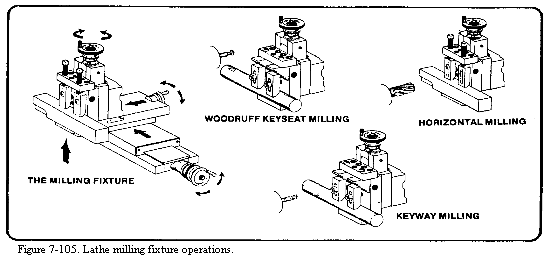
USING MICROMETER CARRIAGE STOP
The micrometer carriage stop, shown in Figure 7-28, is used to accurately position the lathe carriage. Move the carriage so that the cutting tool is approximately positioned. Clamp the micrometer carriage stop to the ways of the lathe, with the spindle in contact with the carriage. The spindle of the micrometer carriage stop can be extended or retracted by means of the knurled adjusting collar. The graduations on the collar, which indicate movement in thousandths of an inch, make it possible to set the spindle accurately. Next, bring the carriage in contact with the micrometer spindle again. The carriage can be accurately positioned within 0.001 inch. This is very useful when you are facing work to length, machining shoulders to an exact length, or accurately spacing internal and external grooves. After making a cut, bring the tool back to the start of the cut by means of the carriage stop. This feature is very useful when you must remove a tool, such as the internal recessing tool, from the hole to take measurements and then reposition it to take additional cuts. Always bring the carriage into contact with the stop by hand. Use power feed to bring the carriage within 1/32 inch of the stop. Move the carriage by hand the remaining distance.
USING STEADY AND FOLLOWER RESTS
General
The steady rest consists of a frame and three adjustable jaws which support the work, as shown in Figure 7-27. One purpose of the steady rest is to prevent springing or deflection of slender, flexible work; another is to furnish auxiliary support for the work to permit heavy cuts to be made; a third is to support work for drilling, boring, or internal threading. The over arm containing the top jaw can be unfastened and swung out of the way so that identical pieces can be removed and replaced without adjusting the jaws.
Bearing Surface
A bearing surface must be provided for the steady rest jaws. The bearing surface is usually machined directly on the work, as shown in Figure 7-106. When the work is too small in diameter to machine the bearing surface or shaped so that it would be impractical to machine one, you can use a cathead to provide the bearing surface. The cathead shown in Figure 7-27, has a bearing you surface, a hole through which the work extends, and adjusting screws. The adjusting screws fasten the cathead to the work. They are also used to align the bearing surface so can use a cathead to provide the bearing surface so that t is concentric to the work axis. Use a dial indicator to ensure concentricity.
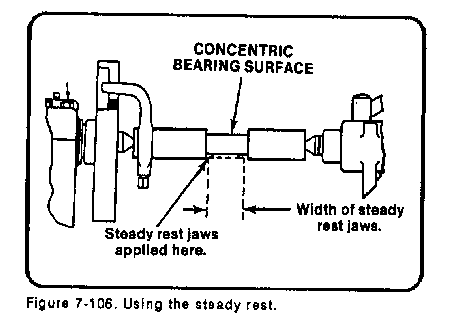
Setting up the Steady Rest
To setup the rest, first machine and polish the portion of the work that is to be used as the bearing surface. Clean the portion of the ways where the steady rest is to be mounted, place the steady rest on the ways and clamp loosely. Open the top of the steady rest and place the workpiece in the chuck with the bearing surface over the adjustable jaws. Clamp the steady rest securely to the ways. Close the top of the steady rest and adjust the jaws to the workpiece. There should be 0.001 inch clearance between the jaws and the workpiece. Tighten the locking screws on the adjustable jaws. Lubricate the bearing surface generously with a heavy oil before turning the lathe on. Proceed with the machining operation Continuously watch the bearing surface and the adjustable jaws to ensure a film of heavy oil is between them. As the machining operation continues, also check the bearing surface and adjustable jaws as when the workpiece heats up it will expand, closing the distance between the jaws and the workpiece.
Using Steady Rest with Headstock Center
When it is not possible to hold the work in the chuck, you can machine with one end supported by the headstock center and the other end supported by the steady rest. Use a leather strap or rawhide thong to tie the work to the driveplate and to prevent it from moving off the headstock center, as shown in Figure 7-107. Mount the work between centers and machine the bearing surface. Set up the steady rest. With the work mounted between the centers, tie the lathe dog, then remove the tailstock center and perform the necessary machining.
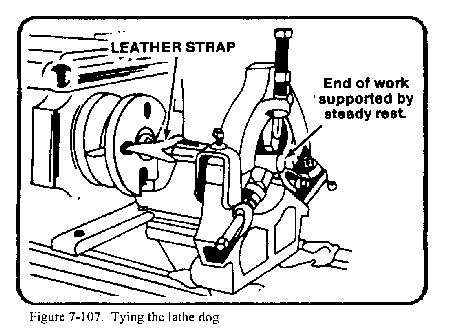
Using the Follower Rest
Long slender shafts that tend to whip and spring while they are being machined require the use of a follower rest (Figure 7-27). The follower rest is fastened to the carriage and moves with the cutting tool. The upper jaw prevents the work from climbing the cutting tool. The lower jaw prevents the work from springing away from the cutting tool The follower rest jaws are adjusted in the same manner as steady rest jaws. The follower rest is often used when long, flexible shafts are threaded, as shown in Figure 7-108. At the completion of each threading cut, remove any burrs that may have formed to prevent them from causing the work to move out of alignment.
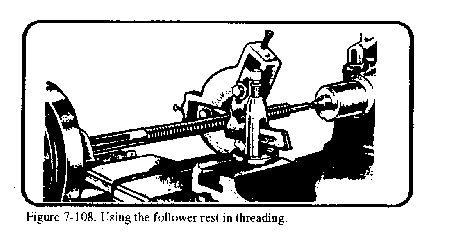
The information was originally compiled by the US Army.
We hope this information was helpful. - Click for PAGE 3 of 3 - Machinist Tables
-
Click for metal turning LATHE MACHINE webpage


Click for American Machine Tools Company Homepage
5862 Northwest Hwy
Chicago IL 60631 USA
Phone: 773-334-5000
Fax: 773-442-0314
Click to email us
American Machine Tools Co.
All rights reserved
Offers from American Machine Tools Corporation include include Terms and Conditions shown on our website.
Liability is strictly limited to those warranties of fitness for purpose and safety as provided by the manufacturer.
Products and Logos in this website are trademarks or registered trademarks of their respective companies or mark holders.